Showing posts with label 1 lower ring. Show all posts

Monday, 21 July 2025

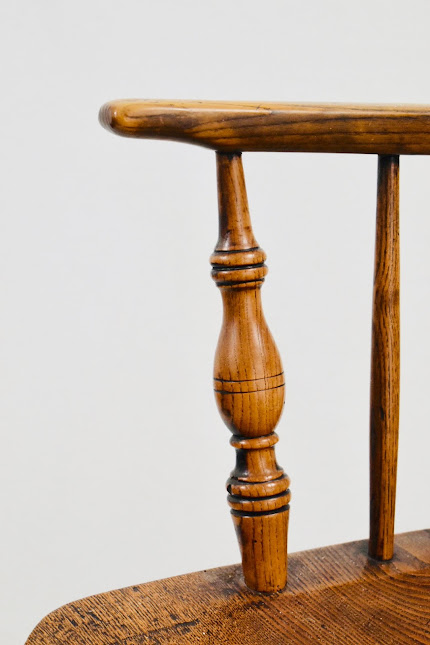
Squared crest rail East Anglian Windsor side chair with 6 laths, shaped underarms fixed to back frame and shaped underarm supports,bell seat, single ring and cove leg turnings x 4, lower ring x 4, crinoline stretcher - WS 230

East Anglian Windsor Chair WS230


Many readers of my comments on this site will be familiar with Mendlesham Windsor chairs, made in Suffolk. However, East Anglia does not have a great tradition of producing Windsor chairs. This is mainly due to the production of "Hollow-seated chairs" there. When this chair was offered for sale at the auction house in Bury St Edmunds in Dec 2019, I decided to add it to my collection. The lot notes stated that it was made mainly from fruitwood with an elm seat and I was impressed by the elegant combination of the skill of wood turning and cabinet making for the back support and arms. What is not immediately apparent is the fluted moulding on all the backsplats, a feature that appears on No. 142 & No. 143, both of which were purchased in East Anglia. The front legs, while having the ring and cove turnery pattern well up towards the seat, as most Thames Valley chairs have, also have a feature that I've seen on othere chairs that I have recorded from that area. Namely, double incised rings to denote where to drill the holes for the stretchers.


© William Sergeant 2024

Monday, 6 November 2023

Typical Lincolnshire spindleback chair - WS228


WS228 Lincolnshire Windsor armchair with 9 long spindles attributed to Roger and Sophia Taylor workshop

The county of Lincolnshire has a great tradition of making spindleback Windsor chairs. Their understated elegance, economy of design and pleasing proportions make them timeless items of furniture which would grace any room. There are plenty on my Flickr feed to choose from and after many years of researching the tradition, I still find chairs which are new to me. Please take a moment to study this one.


It was while visiting a Newark antique centre that I spotted this one for sale at a very reasonable price. There is no maker's name stamp, every component is fashioned from ashwood and it's in remarkably good condition. Everything points to a standard Lincolnshire spindleback Windsor chair, produced at the beginning of the nineteenth century. But which workshop did it come out of? I knew that I had seen those underarm supports before and after a little bit of research I realised that they were the same as picture WS160, which is signed TAYLOR Grantham. 


What surprised me was the fact that every other signed TAYLOR spindleback chairs have only 8 long spindles and 6 short ones. This is, I believe, the very first time that a 9 long and 8 short spindle pattern has ever been recorded.


I have little doubt that it was manufactured in the workshop of Roger and Sophia Taylor during the period 1801 - 1810.


© William Sergeant 2023

Tuesday, 20 April 2021

Lincolnshire bow back stick back Windsor armchair, 8 long sticks, 6 short, turned underarm supports, straight seat sides, ring and cove turned front legs with lower ring, H stretcher with 6 round bobbins, stamped MARSH, from the workshop of MARSH SLEAFORD


Lincolnshire bow back stick back Windsor armchair, 8 long sticks, 6 short, turned underarm supports, straight seat sides, ring and cove turned front legs with lower ring, H stretcher with 6 round bobbins, stamped MARSH, from workshop of MARSH SLEAFORD; front view

This chair turned up in a south Lincolnshire auction in October 2020: even were it not stamped 'MARSH', there are several features which point to Thomas Marsh and his son James. That linked post, which has more biographical details about Thomas (1777 or 1779-1844) and James (1803 - 1870) shows a stamped side chair with the 6 bobbin stretcher. Marsh is the only workshop stamp that has been found with such a stretcher.

Lincolnshire bow back stick back Windsor armchair, 8 long sticks, 6 short, turned underarm supports, straight seat sides, ring and cove turned front legs with lower ring, H stretcher with 6 round bobbins, stamped MARSH, from workshop of MARSH SLEAFORD; 3/4 view

Lincolnshire bow back stick back Windsor armchair, 8 long sticks, 6 short, turned underarm supports, straight seat sides, ring and cove turned front legs with lower ring, H stretcher with 6 round bobbins, stamped MARSH, from workshop of MARSH SLEAFORD; side view

The small chamfer at the end of the terminals of the arm bow is another characteristic Marsh workshop feature. The circular scribe line just visible on the side stretchers to mark the junction point with the cross stretchers is another Marsh workshop habit.


Lincolnshire bow back stick back Windsor armchair, 8 long sticks, 6 short, turned underarm supports, straight seat sides, ring and cove turned front legs with lower ring, H stretcher with 6 round bobbins, stamped MARSH, from workshop of MARSH SLEAFORD; rear view

Another Marsh workshop practice was to pin some of the long sticks with small square wooden pins from the rear of the bows: this chair has two such pins to secure 2nd and 7th long sticks to the back bow, 3 sets of holes for two more, missing the pins, on the 3rd and 6th long sticks (1st at the top in the back bow, 2nd in the arm bow and 3rd in the seat), two more, still with pins, to secure the back bow to the arm bow, and finally 4 more holes, two in the back bow and two in the seat, which appear to have been drilled in the wrong place as they do not align with any of the long sticks, unlike their companions. A momentary lapse of concentration on a Friday afternoon, perhaps.


Lincolnshire bow back stick back Windsor armchair, 8 long sticks, 6 short, turned underarm supports, straight seat sides, ring and cove turned front legs with lower ring, H stretcher with 6 round bobbins, stamped MARSH, from workshop of MARSH SLEAFORD; view from above

Lincolnshire bow back stick back Windsor armchair, 8 long sticks, 6 short, turned underarm supports, straight seat sides, ring and cove turned front legs with lower ring, H stretcher with 6 round bobbins, stamped MARSH, from workshop of MARSH SLEAFORD; detail of arm turning

Lincolnshire bow back stick back Windsor armchair, 8 long sticks, 6 short, turned underarm supports, straight seat sides, ring and cove turned front legs with lower ring, H stretcher with 6 round bobbins, stamped MARSH, from workshop of MARSH SLEAFORD; view from below with detail of leg turnings and stretchers

 
Lincolnshire bow back stick back Windsor armchair, 8 long sticks, 6 short, turned underarm supports, straight seat sides, ring and cove turned front legs with lower ring, H stretcher with 6 round bobbins, stamped MARSH, from workshop of MARSH SLEAFORD; detail of stamp.

The top part of each letter of 'MARSH' is just visible at the back of the seat. There does not appear to be any sign of the 'SLEAFORD' stamp that appears on some Marsh chairs. A pair of side chairs, one of which was exhibited at the exhibition in Alford in 2019 has 'MARSH' stamped on one seat and 'SLEAFORD' on the other. All parts of this chair are of ash.

© Julian Parker 2021

Sunday, 14 June 2020

Lincolnshire hoop back Windsor side chair, with 3-piercing fleur de lys and teardrop piercing splat, 4 long spindles, straight seat sides, ball and cove front leg turning with 1 lower ring and vase-shaped feet, 2 ring back leg turning with vase-shaped feet, H stretcher with darts WS 122

Lincolnshire hoop back Windsor side chair, with 3-piercing fleur de lys and teardrop piercing splat, 4 long spindles, straight seat sides, ball and cove front leg turning with 1 lower ring and vase-shaped feet, 2 ring back leg turning with vase-shaped feet, H stretcher with darts WS 122
This chair was part of the estate of an antique dealer that was offered for sale at the auction house in Grantham in early 2014. Description : the seat is made from ash as are the back legs. The front legs, stretchers and back support are all made from yew wood. All parts appear contemporary with each other and there is no sign of alteration.

There is no maker's stamp but much of this chair design would point to it having been made in Grantham. However the back legs are typical of what would be expected as front legs on a Grantham side chair; just compare with the front legs on WS 96, WS 49 & WS 17. The back hoop, spindles and splat are very similar to a chair which appears at figure NE41 on p. 121 of Der B D Cotton's The English Regional Chair (1990), which is stamped Taylor Grantham. The real enigma is the design of the front legs with their large ball and small cove turnery, the like of which can be seen on WS 72, a chair stamped by Shirley.


© William Sergeant 2018 and 2020

.

Friday, 12 June 2020

Medium bow back Lincolnshire Windsor spindle back armchair stamped AMOS GRANTHAM, with 9 long spindles, 8 short, crook underarms, straight seat sides, ring and cove front leg turnings, with 1 lower ring, plain back legs, H stretcher with darts WS 190 & WS 189

Medium bow back Lincolnshire Windsor spindle back armchair stamped AMOS GRANTHAM, with 9 long spindles, 8 short, crook underarms, straight seat sides, ring and cove front leg turnings, with 1 lower ring, plain back legs, H stretcher with darts WS 190
This is a typical early Lincolnshire windsor armchair. Plain back legs with the front ones having the design of a thin ring above an exaggerated shallow cove, an all-spindle back support and curved underarm supports. This one has an ash seat with yew for the other components. I believe that this is the very essence of a chair that was made in the first period of Windsor chairmaking in the county, namely 1800-1812. 

The name stamp on the edge of the seat is AMOS GRANTHAM, so we know exactly in whose workshop it was made. It came from a house just outside Newark and it had been in the family for many years. It was in a slightly distressed state when I brought it at auction but I got a restorer to make it usable again.

John Amos was a wheelwright and as such ran a business for the first 15 years of his working life making wagons and carts for farmers and merchants as well as servicing ones that were already in use. It was not until 1809 that the first advert by him was posted in the paper searching for journeymen chairmakers. All of the chairs that I have seen from his workshop are of the second period type, which I believe started to be produced in about 1812 but I was not surprised to seen this design by him. This leads me to think that this chair was probably made in the first 3 years of his manufacture, namely 1809-1812.


Bench holdfast marks on medium bow back Lincolnshire Windsor spindle back armchair WS 190 stamped AMOS GRANTHAM WS 189
This picture shows part of the underside of the armbow of this AMOS chair. You can see quite clearly the small areas of cross-hatching that are impressed into the surface of the wood. This was caused by bench holdfasts. These have been used by woodworkers since ancient times and are used, as their name suggests, to hold a piece of wood firmly to the workbench. They are the shape of a swan's neck, with the neck part slipped down a hole in the bench and the crooked head part tapped with a mallet to spread the bend and hold the wood secure. They can easily be released with a sideways tap. 

For the holdfast to grip the wood better, there is cross-hatching filed into the end. This is what has left the marks above. The length of yew wood would be soften in the steam box and the placed against the profile form that it is to be moulded around and once bent, it is held firmly in place while it cools by a series of holdfasts. 


© William Sergeant 2017 and 2020

Tuesday, 9 June 2020

Thomas Simpson, Boston stamped high bow back Lincolnshire Windsor armchair with 5-piercing fleur de lys upper splat, double pierced lower splat, crook underarm supports, 2 x 3 long spindles, 2 x 3 underarm spindles, ring and cove front leg turnings & plain back legs, crinoline stretcher WS 207

Thomas Simpson, Boston stamped high bow back Lincolnshire Windsor armchair with 5-piercing fleur de lys upper splat, double pierced lower splat, crook underarm supports, 2 x 3 long spindles, 2 x 3 underarm spindles, ring and cove front leg turnings with lower ring & plain back legs, crinoline stretcher WS 207
Another chair from the collection of James Drake, this time a yew wood chair with reduced legs, but stamped clearly on the edge of the seat: T SIMPSON & Co BOSTON. There is another Simpson Windsor armchair at WS 123, and if you compare the back splat of both, I think that you would agree with me that both were made from the same master pattern, with the main difference being that this chair has a crinoline stretcher whereas WS 123 has an H stretcher with darts.

© William Sergeant 2020

Monday, 8 June 2020

Medium bow back Lincolnshire Windsor armchair stamped TAYLOR GRANTHAM, turned underarm supports, 8 long spindles, 2 x 3 underarm spindles, ring and cove front leg turnings with single lower ring & plain back legs, H stretcher with cross stretcher turned with darts WS 85

Medium bow back Lincolnshire Windsor armchair stamped TAYLOR GRANTHAM, turned underarm supports, 9 long spindles, 2 x 4 underarm spindles, ring and cove front leg turnings with single lower ring & plain back legs, H stretcher with cross stretcher turned with darts WS 85
I happen to find this one at the Newark Antiques Fair and I was convinced it was made by Marsh of Sleaford but on close inspection there is a faint stamp on the rear of the seat which says TAYLOR GRANTHAM. Fortunately no one had noticed this maker's mark and it joined my collection for a very small fee. The underarm turnings are so similar to Marsh of Sleaford that only when they are stood next to each other can you spot the differences. Compare this chair with WS 29 and you will see what I mean.

Other differences are that Taylor has 8 long spindles and 6 short, whereas Marsh uses 9 long and 8 short; Marsh puts a slight chamfer on the underside of the end of the arm bow, absent from the Taylor chair. The ring on the front legs of the Taylor chair is slightly deeper than that on the Marsh.

© William Sergeant 2018 and Julian Parker 2020 

Thursday, 28 May 2020

Lincolnshire high back bow back Windsor armchair with 5-piercing fleur de lys upper splat with lower diamond, double pierced lower splat, 6 long spindles, 8 short, no underarms, straight seat sides, ring and cove front leg turnings with1 lower ring x 4, crinoline stretcher WS 153 & WS 152

Lincolnshire high back bow back Windsor armchair with 5-piercing fleur de lys upper splat with lower diamond, double pierced lower splat WS 153

Lincolnshire high back bow back Windsor armchair with 5-piercing fleur de lys upper splat with lower diamond, double pierced lower splat WS 153b
Another Windsor chair of little value, mainly due to the huge fracture in the armbow (which can not be seen in these pictures) and the missing underarm supports. However, it is not without some interesting points even though the maker did not stamp it. The seat is made from ash while the rest of the chair is made from yew wood. Every feature would suggest a Grantham maker but without the underarm supports for some design clues it is difficult to work out who made this chair. However, one of the benefits of keeping pictures of stamped chairs is that they make a hugely important reference library.

If you have read my few lines under picture WS 131 you will have noted that I normally take no notice of the design of the cut out fret work on back splats. However the only exception to that rule is a tiny feature that appears on several AMOS stamped chairs. Compare this back splat to the signed chair in picture WS 132 and I will leave you to draw your own conclusions.


© William Sergeant 2015 and 2020.


Tuesday, 26 May 2020

Lincolnshire comb back rocking side chair with turned stiles, 6 long spindles, straight seat sides, ring and cove front leg turnings with 1 lower ring, plain back legs, H stretcher WS 93

Lincolnshire comb back side rocking side chair WS 93
From the collection of Steven Voyt. This the first Lincolnshire side chair on rockers that I have ever seen. On close inspection it appears to be all original and genuine. Although it is unstamped,  just compare the turned back supports with WS 90, which is stamped Camm Grantham.  I think the two chairs are near enough identical to say that they were made in the same workshop. The major difference between the two is in the front leg design: while this one has two rings WS 90 has a ring and a cove; this would indicate a subtle change with time: the two ring design being recognised as coming later than the ring and cove.

© William Sergeant 2013 and 2020

Saturday, 16 May 2020

Lincolnshire comb back Windsor side chair stamped CAMM GRANTHAM with turned stiles, 6 long spindles, straight seat sides, ball turning and thin cove front legs, plain back legs, H stretcher WS 94

Lincolnshire comb back Windsor side chair with turned stiles, 6 long spindles, straight seat sides, ball turning and thin cove front legs, plain back legs, H stretcher WS 94
From a private collection. The story behind this chair is that it was rescued from a skip, with a split seat and a broken stile (outer back support). It has been skillfully repaired and a replacement turned back support made. This stamped Grantham chair was way too good to be discarded and has now been recorded for all to enjoy and for academic research. Stamped with a bold impression on the seat edge: CAMM GRANTHAM.

© William Sergeant 2013

Friday, 15 May 2020

2 x Lincolnshire and a Beverley Windsor side chair, with curved crest rails, turned stiles, 6 , 7 and 5 long spindles, straight seat sides, ring and cove front legs with 1 lower ring, plain back legs, H stretchers, 2 with darts WS 124

2 x Lincolnshire and a Beverley Windsor side chair, with curved crest rails, turned stiles, 6 , 7 and 5 long spindles, straight seat sides, ring and cove front legs with 1 lower ring, plain back legs, H stretchers, 2 with darts WS 124
Take a good look at the three chairs above. Many of you will recognise the right-hand chair as a splendidly crafted chair from Sleaford and stamped by Marsh, with 5 spindles across the back. The left-hand unstamped chair is of a similar date and is what you may expect to have been made in Grantham, with 6 spindles across the back. Now study the middle chair: it is such a mystery!

I happened across this chair at the Newark Antique fair at the beginning of April 2014. From a distance it was instantly recognisable as a Lincolnshire side chair but on closer inspection there were many aspects that I had not seen before. The row of 7 spindles was a first for me and the design turnery of the two outside spindles (stiles) is quite different from anything previously recorded . The elm seat is wider and deeper than the standard small seat you would expect and although the chair had been well used it is quite evident it was made by a very competent workshop. It appears to have been reduced in height in the past (hence the ramekin plinths!) and the seat has twisted to give a slightly distorted appearance.

I quizzed the dealer as to the history of this chair and was told that it came from a house clearance in Beverley, Yorkshire, East Riding. It was then that I remembered that I had spoken to the same person last year when he had 3 other chairs of the same design. Foolishly I had not photographed them and he told me they had been purchased by an American dealer, so there is little chance of ever seeing those again. I secured the purchase of this single chair so I could record it here, calling it a Beverley chair for want of a better name or until I discover who made it. The dealer also told me that he had had other similar chairs through his business in the past . Any other information on this design would be welcome: it may well be that there is a previously unrecorded maker from the East Riding of Yorkshire who was responsible for these lookalike Lincolnshire side chairs.


© William Sergeant 2014 and 2020

Thursday, 14 May 2020

3 x Lincolnshire Windsor chairs by Marsh of Sleaford, one high back bow back, one hoop back side chair, and one medium bow back, with 9, 7 and 9 long spindles, bell shaped seats, turned underarms x 2, ring and cove turned front legs with 1 lower ring, plain back legs, H stretcher with darts WS 115

3 x Lincolnshire Windsor chairs by Marsh of Sleaford, one high back bow back, one hoop back side chair, and one medium bow back, with 9, 7 and 9 long spindles, bell-shaped seats, turned underarms x 2, ring and cove turned front legs with 1 lower ring, plain back legs, H stretcher with darts WS 115
All three chairs bear the maker's stamp on the rear upper part of the seat: MARSH SLEAFORD. This picture demonstrates the interchangeability of component parts: the legs are all identical (accepting that the chair on the left has been reduced in height some time ago). Thomas and James Marsh developed an elegant and balanced turned leg and they stuck by it faithfully through out many years and never went for the two ring motif on later chairs as other makers did.  The underarm turnings are consistent on the two armchairs and all three chairs have the same H stretcher with darts.

© William Sergeant 2013 and 2020

Tuesday, 12 May 2020

Comb back Lincolnshire side chair by Marsh of Sleaford with curved crest rail, turned stiles, 5 long spindles, straight seat sides, ring and cove turnings on the front legs with 1 lower ring, plain back legs and H stretcher with darts WS 14

Comb back Lincolnshire side chair by Marsh of Sleaford WS 14

Side chair with MARSH SLEAFORD impressed on upper rear surface of seat - this may relate to James Marsh (baptised 19th August 1803) who lived and worked in Jermyn St. Sleaford as a chair maker for all his life. This chair is one of a set of three that were offered for sale in a Lincoln auction in March 2001 and no mention was made in the sale catalogue that all were signed to the rear of the seat. There equally a good chance that the father of James made these chairs: his name was Thomas . The parish register of St Denys Sleaford shows Thomas's burial aged 67 on 25 April 1844. No will has yet been tracked down.

As I have said elsewhere, Marsh made really good chairs and for a very good reason. On the front page of the newly started Sleaford Gazette in the summer of 1858 there was an advertisement by Mr Darlow's Upholstery Establishment which sold cottage furniture including Windsor chairs at 2 shillings each, on South Street, Sleaford. Also on Westgate, Sleaford there was Mr William Robinson selling London, Birmingham and Sheffield goods including Windsor chairs, wholesale and retail! Messrs. Marsh must have made really good chairs at competitive prices to compete with the shops in town.


© William Sergeant 2012 and 2020 

Sunday, 10 May 2020

Medium bow back Lincolnshire Windsor armchair stamped MARSH of Sleaford with 9 long spindles, 6 short, crook underarms, bell-shaped seat, ring and cove front legs with 1 lower ring, plain back legs, H stretcher WS 105

Medium bow back Lincolnshire Windsor armchair stamped MARSH of Sleaford with 9 long spindles, 6 short, crook underarms, bell-shaped seat, ring and cove front legs with 1 lower ring, plain back legs, H stretcher WS 105
Many thanks to Michael Pashby Antiques in New York City for providing this wonderful image from his stock . It was available along with 9 side chairs by the same maker - all signed. The crook underarm support is the first I have ever seen by this father and son pair of makers - it probably was made by the father (Thomas) and fully deserves to be recorded here. See WS 101 & WS 29 for chairs by the same maker.

© William Sergeant 2013 and 2020

Saturday, 9 May 2020

Lincolnshire comb back Windsor armchair, with curved crest rail, turned stiles, 7 long spindles, 8 shirt, turned underarms, bell-shaped seat sides, ring and cove front leg turnings with 1 lower ring, plain back legs, H stretcher with 6 bobbin turning WS 101

Lincolnshire comb back Windsor armchair, probably by Marsh of Sleaford WS 101

The Marsh that got away. This lovely chair was offered at auction in the autumn of 2012 just to the south of London. I was not able to view but was happy to bid on the picture alone. A signed chair by Marsh of Sleaford appears at figure NE133 on p. 135 of Dr B D Cotton's The English Regional Chair (1990) and I was sure that this was by the same maker; the row of turned bobbins on the cross stretcher and the underarm turnings are a hallmark of this maker. Unfortunately I ended up as the underbidder!

© William Sergeant 2012 and 2020

Monday, 20 April 2020

Lincolnshire hoop back Windsor side chair, stamped TAYLOR GRANTHAM, with 4 long spindles, splat with vase and teardrop piercing, straight seat sides, ring and cove front leg turnings with lower ring, plain back legs and H stretcher WS 81

Lincolnshire hoop back Windsor side chair, stamped TAYLOR GRANTHAM, with 4 long spindles, splat with vase and teardrop piercing, straight seat sides, ring and cove front leg turnings with lower ring, plain back legs and H stretcher WS 81


A well-balanced Lincolnshire Windsor side chair from the collection of Brian Gray. This a good quality splat back side chair with a bold stamp of Taylor of Grantham on the upper rear of the seat. A beautifully crafted chair, elegantly designed and well made. Pre 1809.

© William Sergeant 2020

Sunday, 19 April 2020

Unusual Lincolnshire scroll back Windsor armchair stamped Taylor, bar back, pierced cross rail, turned lower rail, straight seat sides, ring & cove front leg turnings with lower ring, plain back, H stretcher, shaped underarms, sawn and scrolled back uprights WS 82

Unusual Lincolnshire scroll back Windsor armchair stamped Taylor, bar back, pierced cross rail, turned lower rail, straight seat sides, ring & cove front leg turnings with lower ring, plain back, H stretcher, shaped underarms, sawn and scrolled back uprights WS 82
Windsor armchair signed TAYLOR GRANTHAM from the fine collection of Brian Gray. This an enigma as it has many features that you would not associate with an East Midlands chair. This is the only chair of this pattern that has ever been recorded and is unusual for two reasons. Firstly, it has very few turned components: more like a chair that a cabinet maker would produce, and secondly the design is what I would expect to be produced in the Thames Valley region. It demonstrates that there are probably other design of chairs that were produced by the Lincolnshire chair makers and as yet undiscovered and unrecorded.

© William Sergeant 2015 and 2019

Saturday, 18 April 2020

Lincolnshire Windsor hoop back side chair with 6 long spindles, straight seat sides, ring and cove turned front legs with lower ring, plain back legs, H stretcher WS 147

Lincolnshire Windsor hoop back side chair with 6 long spindles, straight seat sides, ring and cove turned front legs with lower ring, plain back legs, H stretcher WS 147
The first spindle back side chair to be recorded; faintly stamped at the upper rear of the seat TAYLOR GRANTHAM. Made entirely out of ash and from the same farmhouse as WS 146. It's hardly surprising that one of this pattern by this maker would eventually turn up as all the Grantham makers appear to have made this design and figure NE41 at p. 121 of Dr B D Cotton's The English Regional Chair (1990) is the same but with a back splat.

So which one of the Taylors made this one - Cotton lists James, John, John junior, Joseph and William in the back of his book - it could be any of them? However recent research has discovered another unrecorded Taylor by the name of Roger. Let me explain: while browsing through some old paper advertisements I came across one seeking a Journeyman Windsor chair maker who would have constant employ and wages according to his merit by applying to Mr Roger Taylor, Windsor chairmaker of Grantham. This was in the Stamford Mercury in July 1800. Further investigation has revealed that on 7th Jan 1782 there was the marriage of Roger Taylor to Sophia Smith and later that year, on 15th October, there was registered the birth of their first child John. He was followed by William in March 1785 and James in July 1787.  I have Robert Williams to thank for informing me that a William Taylor was apprenticed to William Allison, joiner , of Grantham on the 6th December 1799 for the sum of £21 for 7 years. This means that there is a strong possibility that in the 1780s or 1790s Windsor chairs were being made in Grantham by Roger Taylor and that the three chairmakers mentioned by Cotton all were the children or grandchildren of Roger.

I quickly found out that Roger died and was buried in Grantham one year after he put the advertisement in the paper, in Oct 1801. This means that his eldest son John would have been only 17 years old at the time of his death and not even finished his apprenticeship, if he was doing one. So who would have run the business of chairmaking? Well the answer lies in an advertisement that appeared in the Stamford Mercury in June 1802 the year after the death of Roger: his wife Sophia placed an advertisement saying that she is to continue the business and asking for journeymen to apply for work making chairs for her.  The advertisement was signed by Mrs S. Taylor, Windsor and Fancy Chair-manufacturer. 


Another advertisement by by Mrs S. Taylor, Windsor and Fancy Chair-manufacturer, appeared in the Stamford Mercury in February 1809. It was advertising for an apprentice to start immediately at Windsor and fancy chair-manufacturer and after the time served the young man would be entitled to become a Freeman of the borough of Grantham.

On a final note, I would like you to ponder on this: the burial register notes that Roger was 38 at the time of his death which means that if he had done an apprenticeship it would have been in the late 1770s, which really places him at the very beginning of the Grantham Windsor chair making tradition Who taught him and where did he learn his skills?

Click on this link to see me give a talk to the Regional Furniture Society conference in London, March 2019, about the Taylors of Grantham.

© William Sergeant 2014 and 2020

Thursday, 16 April 2020

Lincolnshire medium bow back Windsor armchair stamped TAYLORS with quatrefoil and fleur de lys splat, 6 long spindles, 8 short, crook underarms, bell shaped seat, ring and cove front leg turnings, plain back legs, H stretcher with darts WS 194

Lincolnshire medium bow back Windsor armchair stamped TAYLORS with quatrefoil and fleur de lys splat, 6 long spindles, 8 short, crook underarms, bell shaped seat, ring and cove front leg turnings, plain back legs, H stretcher with darts WS 194

A long time ago, a fellow collector of Lincolnshire Windsor chairs had mentioned to me that he had a couple of stamped Taylor chairs in his collection. I had never seen them and wasn't overly interested as I have my own chairs signed by the same maker. However, on a recent visit to his house, I noticed this chair above - I knew that it was made by William Taylor who signed his chairs TAYLORS. I commented that this must be a new addition, whereon he replied that he had told me about it years ago. I had misinterpreted what he had said; I thought he meant Taylor not TAYLORS! The difference is subtle but so important.

I know that William Taylor signed chairs from his workshop as he states the same in an advert in the Stamford Mercury- WS 166 here - and that his signed chairs are very rare. My research has revealed that he left the security of his mother's workshop in December 1811 to set up his own business; at the same time he took on the apprentice William Shirley senior who was halfway through his 7-year tuition having started it under John Taylor.

This chair encapsulates so many features regarding my research. With the help of Chris Goodwin, who is a descendant of the Taylors of Grantham, I can reveal that William Taylor gave up chairmaking on the 7th October 1815 to work for the Post Office as a mail coach guard, something he did for the next 30 years. This means that this chair can be precisely dated to the 4 years before Oct 1815. The implications of this are profound - no other writer on this subject has been able to confirm when the backsplat and H stretcher were introduced into the design of Lincolnshire chairs but this is firm date evidence.

The chair itself is made entirely out of ash wood, having a thick seat and of robust construction, weighing in at an impressive 15 pounds - this chair was made to last. The backsplat has a particularly pleasing design motif. The seat is flared towards the front to give more room to the front legs which leads to an elegant well-balanced design.

But the most outstanding discovery for me was that this collector had been lucky to purchase two of these chairs, in the same lot, from an auction house in Cumbria.


© William Sergeant 2018 and 2020

Tuesday, 14 April 2020

Lincolnshire medium bow back Windsor armchair probably William Taylor, with 3 quatrefoil and flea de lys pierced splat, 6 long spindles, 8 short, crook underarms, bell-shaped seat, ring and cove front leg turnings, plain back legs, crinoline stretcher WS 165

Lincolnshire medium bow back Windsor armchair probably William Taylor, with 3 quatrefoil and flea de lys pierced splat, 6 long spindles, 8 short, crook underarms, bell-shaped seat, ring and cove front leg turnings, plain back legs, crinoline stretcher WS 165
Shaped elm seat, two inches thick , chamfered under edges. Back support all ash wood except cherry splat . Eight short and six long spindles. Distinctive quatrefoil pattern on splat. Four blind square pins on back bow and five on the arm bow let in from the back.

Ash wood front legs with typical Lincolnshire ring and cove decoration, slightly shortened, one with evidence of torn fibres from cleaving blank. One plain ash back leg and one elm replacement leg and two elm replacement short stretchers. Ash crinoline stretcher. Weight : 13 ¼ lbs.

This chair was made by William Taylor, of that I have no doubt. If you look in Dr B D Cotton's The English Regional Chair (1990) at figure NE 28 on p. 118 you will see an identical chair which is signed Taylors Grantham. That is the stamp of William Taylor of Grantham. Also on the original rear leg there is an incised mark to show where the hole centre is to be drilled for the cross stretcher. I have only seen one chair with this constructional aid before and that is on chair WS 126 and if you look at that chair you will see that it is also signed Taylors Grantham.


© William Sergeant 2015 and 2020