Showing posts with label East Anglia. Show all posts

Monday, 21 July 2025

Squared crest rail East Anglian Windsor side chair with 6 laths, shaped underarms fixed to back frame and shaped underarm supports,bell seat, single ring and cove leg turnings x 4, lower ring x 4, crinoline stretcher - WS 230

East Anglian Windsor Chair WS230


Many readers of my comments on this site will be familiar with Mendlesham Windsor chairs, made in Suffolk. However, East Anglia does not have a great tradition of producing Windsor chairs. This is mainly due to the production of "Hollow-seated chairs" there. When this chair was offered for sale at the auction house in Bury St Edmunds in Dec 2019, I decided to add it to my collection. The lot notes stated that it was made mainly from fruitwood with an elm seat and I was impressed by the elegant combination of the skill of wood turning and cabinet making for the back support and arms. What is not immediately apparent is the fluted moulding on all the backsplats, a feature that appears on No. 142 & No. 143, both of which were purchased in East Anglia. The front legs, while having the ring and cove turnery pattern well up towards the seat, as most Thames Valley chairs have, also have a feature that I've seen on othere chairs that I have recorded from that area. Namely, double incised rings to denote where to drill the holes for the stretchers.


© William Sergeant 2024

Tuesday, 31 October 2023

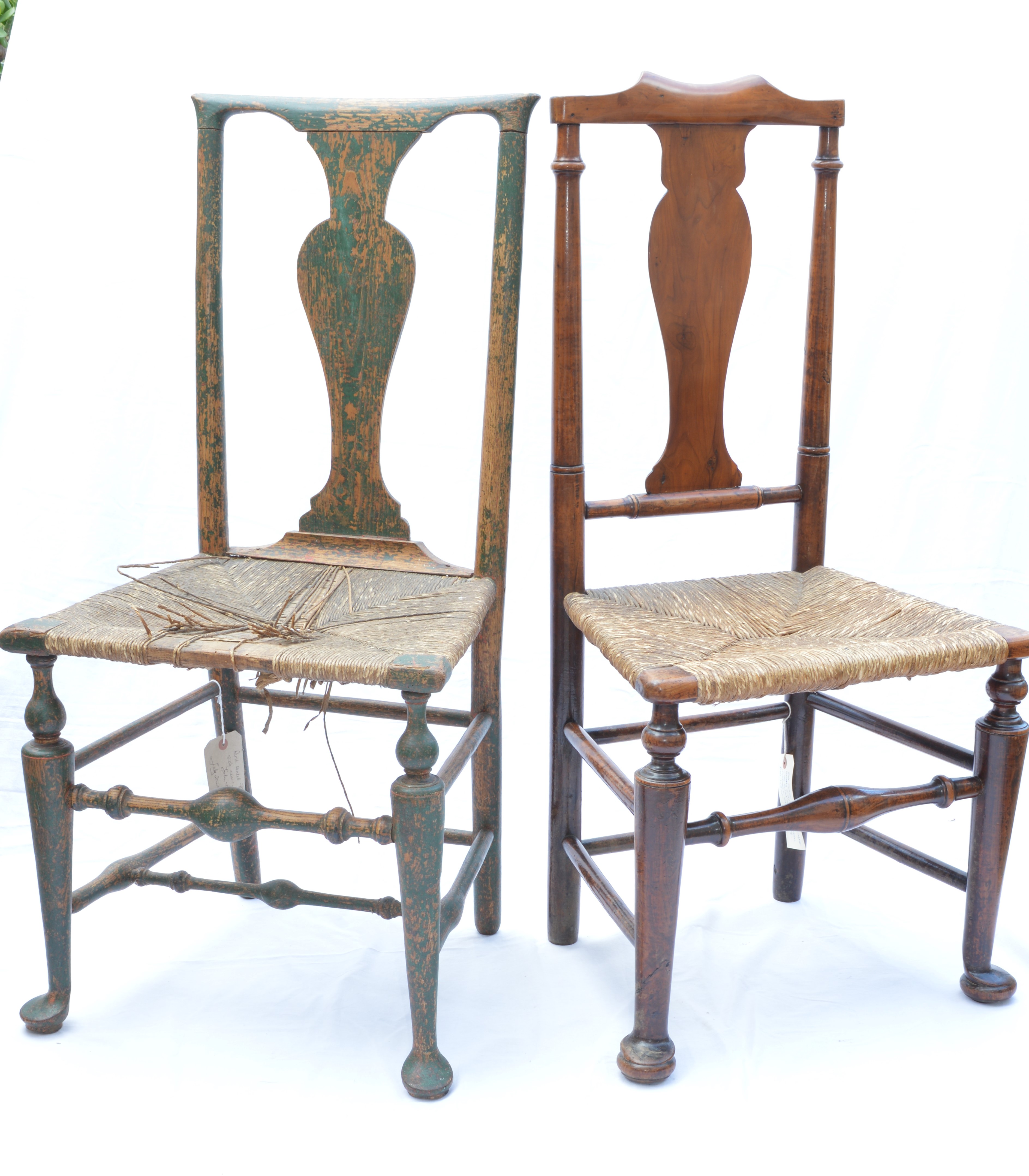
East Anglian chairs - WS 227


Please study the two rush seated chairs which I acquired at completely different times. The left hand one still has large areas of original green paint, very old rushing which has seen much use and a mixture of turned and shaped components. The front leg is rather well produced, with a pronounced offset turning to give a well defined foot. I have seen other similar front legs but had no idea where they were made, though I suspected it was somewhere close to Lincolnshire. 

The right hand chair was offered for sale at Golding Young in Lincoln during March 2023 and was knocked down to me for a hammer price of £75. I had not been to the viewings but I was delighted when I collected it next day, even the auctioneer commented that this well made chair had caught his eye. It had obviously come from a good home and been well cared for, being re-rushed a long time ago and well polished. The wood used was either cherry or some other fruit wood and judging by the craftsmanship that was employed to make the turned pieces, it had come from a very accomplished workshop. 

I will leave it up to the reader to assess the similarities between the two chairs.


One of the benefits of being a member of the Regional Furniture Society is that most other members are keen furniture historians. It was through the society that I meet Robert Williams, who lives just to the north of Cambridge and we have exchanged information on our respective regional chair collections over many years. A defining feature that he believes is common among his local chairs is the change in diameter of the back leg, above seat level. This is not a feature that I have ever seen on chairs that I associate with Lincolnshire rush seated chairs. He even has evidence to link this design pattern to Mendlesham in Suffolk. His immediate impression, when I shared some images with him, was that it indeed was from East Anglia.


© William Sergeant October 2023

Monday, 1 June 2020

East Anglian cabinetmaker's plum wood square back armchair, crest and cross rails squared with two tapered laths either side of an amphora-shaped splat, with curved rear legs, tapered front legs, board seat, curved arms morticed into ogee underarm supports, single stretcher all round WS 193

East Anglian cabinetmaker's plum wood square back armchair, crest and cross rails squared with two tapered laths either side of an amphora-shaped splat, with curved rear legs, tapered front legs, board seat, curved arms morticed into ogee underarm supports in the Hepplewhite manner, single stretcher all round WS 193
An auction house near Stamford offered this chair for sale in May 2016, there were other items of interest included in the lots so I went along to the viewing. On examining this chair, which was rightly described as fruitwood, I found it to be in very poor condition with numerous crude repairs and both back legs were completely broken at seat level. I recognised it to be a cabinet maker's chair from East Anglia and made out of plumwood. It must have looked beautiful when it was first made over 200 years ago. On the day of the auction, much against my better judgment, I decided to bid for it as I knew there was little chance of ever purchasing a plumwood chair ever again. The opening bid was for five pounds, the second bid was mine at six pounds and much to my surprise it was knocked down to me.

Well this ugly duckling turned into a fine handsome swan after I let a good friend and restorer work his magic on it. I couldn't believe the transformation - I now have a beautiful Georgian armchair, strong and stable, taking pride of place in my sitting room. A chair very similar to this one, but with two piercings through the central splat appears at figure EA11 on p. 218 of Dr B D Cotton's The English Regional Chair (1990).


© William Sergeant 2018 and 2020


Friday, 3 April 2020

Bill and Gerry Cotton visiting William Sergeant in Lincolnshire in 2013

Bill and Gerry Cotton visiting William in Lincolnshire in 2013 WS 104
I was honored to be visited by the county's leading authority on regional chairs, Bill Cotton and his wife, Gerry. They stayed several hours and we had so much to talk about; it only took a few minutes for Gerry to find a really faint maker's stamp on a chair that I had had for many years and never noticed! This picture shows them stripping the rushing off a chair attributed to East Anglia; some of the rushing bars were cracked and the chair was a danger to anyone who sat in it. We also hoped that we might find some name on these hidden bars but were out of luck.

© William Sergeant 2013

Saturday, 28 September 2019

Squared back East Anglian Windsor side chair with 7 staggered long spindles, framed back, bell seat, single ring leg turnings x 4, H stretcher with darts

WS 142 squared back East Anglian Windsor side chair 

This is the side chair that goes with No 143. If you study the Mendlesham chairs in Dr B D Cotton’s The English Regional Chair (1990) there is only a single side chair shown which makes this worthy of inclusion here just on that fact alone.

Many thanks to Tony and Jan from Suffolk for allowing me to publish these pictures here.

© William Sergeant 2019


Squared back East Anglian Windsor armchair with 7 staggered long spindles, shaped underarms fixed to back frame and shaped underarm supports, bell seat, single ring leg turnings x 4, H stretcher with darts

WS 143 Squared back East Anglian Windsor armchair

There is absolutely nothing about this chair to associate it with Lincolnshire but it is just such an elegant chair that it deserves a wider audience.  I had seen it briefly before and asked its owner to bring it along to my Chair Study day on 22 September 2014.

The most outstanding feature, which is not immediately obvious from this picture, are the staggered back spindles; if you look where they meet the seat you see they are not in line. The next important item to note is that the upper half could well have been made by a cabinet maker and the lower half by a turner. The overall appearance is similar to the Mendlesham chairs that appear in Dr B D Cotton’s The English Regional Chair (1990) pp.246-256. However there are some notable subtle differences - every one in Cotton's book has double top bars and none of the vertical back spindles reach all the way down to the seat board whereas this chair has a single top bar and the vertical spindles are let into the seat. One overiding feature tends to unite the Mendlesham chairs: it is the incise mark on the legs to denote where the stretchers are to be drilled and let in - those marks appear on this chair and No 142.


© William Sergeant 2019

Saturday, 27 April 2019

36


Cabinet maker’s armchair, from Batemans Auctioneers, Stamford. Re-rushed seat. These last three chairs, No. 34, No. 35 & No. 36, have every component made out of elm wood; pattern of chairs is not specific to Lincs but to Eastern coastal counties. Even the smallest town in Georgian times would have had a cabinet maker’s workshop, producing all manner of domestic furniture including these elegant chairs. (1780-1830).