Showing posts with label 8 long spindles. Show all posts

Monday, 6 November 2023

Typical Lincolnshire spindleback chair - WS228


WS228 Lincolnshire Windsor armchair with 9 long spindles attributed to Roger and Sophia Taylor workshop

The county of Lincolnshire has a great tradition of making spindleback Windsor chairs. Their understated elegance, economy of design and pleasing proportions make them timeless items of furniture which would grace any room. There are plenty on my Flickr feed to choose from and after many years of researching the tradition, I still find chairs which are new to me. Please take a moment to study this one.


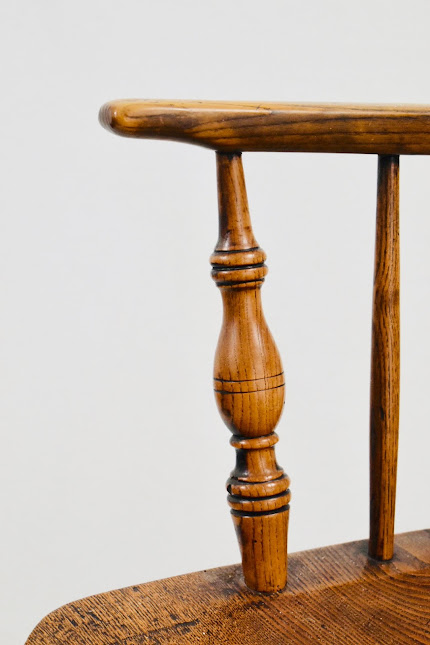
It was while visiting a Newark antique centre that I spotted this one for sale at a very reasonable price. There is no maker's name stamp, every component is fashioned from ashwood and it's in remarkably good condition. Everything points to a standard Lincolnshire spindleback Windsor chair, produced at the beginning of the nineteenth century. But which workshop did it come out of? I knew that I had seen those underarm supports before and after a little bit of research I realised that they were the same as picture WS160, which is signed TAYLOR Grantham. 


What surprised me was the fact that every other signed TAYLOR spindleback chairs have only 8 long spindles and 6 short ones. This is, I believe, the very first time that a 9 long and 8 short spindle pattern has ever been recorded.


I have little doubt that it was manufactured in the workshop of Roger and Sophia Taylor during the period 1801 - 1810.


© William Sergeant 2023

Tuesday, 20 April 2021

Lincolnshire bow back stick back Windsor armchair, 8 long sticks, 6 short, turned underarm supports, straight seat sides, ring and cove turned front legs with lower ring, H stretcher with 6 round bobbins, stamped MARSH, from the workshop of MARSH SLEAFORD


Lincolnshire bow back stick back Windsor armchair, 8 long sticks, 6 short, turned underarm supports, straight seat sides, ring and cove turned front legs with lower ring, H stretcher with 6 round bobbins, stamped MARSH, from workshop of MARSH SLEAFORD; front view

This chair turned up in a south Lincolnshire auction in October 2020: even were it not stamped 'MARSH', there are several features which point to Thomas Marsh and his son James. That linked post, which has more biographical details about Thomas (1777 or 1779-1844) and James (1803 - 1870) shows a stamped side chair with the 6 bobbin stretcher. Marsh is the only workshop stamp that has been found with such a stretcher.

Lincolnshire bow back stick back Windsor armchair, 8 long sticks, 6 short, turned underarm supports, straight seat sides, ring and cove turned front legs with lower ring, H stretcher with 6 round bobbins, stamped MARSH, from workshop of MARSH SLEAFORD; 3/4 view

Lincolnshire bow back stick back Windsor armchair, 8 long sticks, 6 short, turned underarm supports, straight seat sides, ring and cove turned front legs with lower ring, H stretcher with 6 round bobbins, stamped MARSH, from workshop of MARSH SLEAFORD; side view

The small chamfer at the end of the terminals of the arm bow is another characteristic Marsh workshop feature. The circular scribe line just visible on the side stretchers to mark the junction point with the cross stretchers is another Marsh workshop habit.


Lincolnshire bow back stick back Windsor armchair, 8 long sticks, 6 short, turned underarm supports, straight seat sides, ring and cove turned front legs with lower ring, H stretcher with 6 round bobbins, stamped MARSH, from workshop of MARSH SLEAFORD; rear view

Another Marsh workshop practice was to pin some of the long sticks with small square wooden pins from the rear of the bows: this chair has two such pins to secure 2nd and 7th long sticks to the back bow, 3 sets of holes for two more, missing the pins, on the 3rd and 6th long sticks (1st at the top in the back bow, 2nd in the arm bow and 3rd in the seat), two more, still with pins, to secure the back bow to the arm bow, and finally 4 more holes, two in the back bow and two in the seat, which appear to have been drilled in the wrong place as they do not align with any of the long sticks, unlike their companions. A momentary lapse of concentration on a Friday afternoon, perhaps.


Lincolnshire bow back stick back Windsor armchair, 8 long sticks, 6 short, turned underarm supports, straight seat sides, ring and cove turned front legs with lower ring, H stretcher with 6 round bobbins, stamped MARSH, from workshop of MARSH SLEAFORD; view from above

Lincolnshire bow back stick back Windsor armchair, 8 long sticks, 6 short, turned underarm supports, straight seat sides, ring and cove turned front legs with lower ring, H stretcher with 6 round bobbins, stamped MARSH, from workshop of MARSH SLEAFORD; detail of arm turning

Lincolnshire bow back stick back Windsor armchair, 8 long sticks, 6 short, turned underarm supports, straight seat sides, ring and cove turned front legs with lower ring, H stretcher with 6 round bobbins, stamped MARSH, from workshop of MARSH SLEAFORD; view from below with detail of leg turnings and stretchers

 
Lincolnshire bow back stick back Windsor armchair, 8 long sticks, 6 short, turned underarm supports, straight seat sides, ring and cove turned front legs with lower ring, H stretcher with 6 round bobbins, stamped MARSH, from workshop of MARSH SLEAFORD; detail of stamp.

The top part of each letter of 'MARSH' is just visible at the back of the seat. There does not appear to be any sign of the 'SLEAFORD' stamp that appears on some Marsh chairs. A pair of side chairs, one of which was exhibited at the exhibition in Alford in 2019 has 'MARSH' stamped on one seat and 'SLEAFORD' on the other. All parts of this chair are of ash.

© Julian Parker 2021

Friday, 16 April 2021

Lincolnshire bow back spindle back armchair stamped WILSON GRANTHAM, with 8 long spindles, 6 short, turned underarms, straight seat sides, ring and cove front leg turnings, plain back legs, H stretcher with darts


Lincolnshire bow back spindle back armchair stamped Wilson Grantham, with 8 long spindles, 6 short, turned underarms, straight seat sides, ring and cove front leg turnings, plain back legs, H stretcher with darts, 3/4 view


Lincolnshire bow back spindle back armchair stamped Wilson Grantham, with 8 long spindles, 6 short, turned underarms, straight seat sides, ring and cove front leg turnings, plain back legs, H stretcher with darts, view from above
Lincolnshire bow back spindle back armchair stamped Wilson Grantham, with 8 long spindles, 6 short, turned underarms, straight seat sides, ring and cove front leg turnings, plain back legs, H stretcher with darts, detail of arm turning 

Lincolnshire bow back spindle back armchair stamped Wilson Grantham, with 8 long spindles, 6 short, turned underarms, straight seat sides, ring and cove front leg turnings, plain back legs, H stretcher with darts, side view

Lincolnshire bow back spindle back armchair stamped Wilson Grantham, with 8 long spindles, 6 short, turned underarms, straight seat sides, ring and cove front leg turnings, plain back legs, H stretcher with darts, rear view

Lincolnshire bow back spindle back armchair stamped Wilson Grantham, with 8 long spindles, 6 short, turned underarms, straight seat sides, ring and cove front leg turnings, plain back legs, H stretcher with darts, stamp


For a short piece about John Wilson (1779 - 1837) see this post.

© Julian Parker 2021

Thursday, 18 June 2020

Lincolnshire comb back armchair by Marsh Sleaford, with curved crest rail, with 8 long spindles, the outer of which are turned stiles above the arm bow, which is chamfered at its ends, 6 short spindles, turned underarms, straight seat sides, ring and cove front leg turnings with 1 lower ring, plain back legs, H stretcher with darts WS 208

Lincolnshire comb back armchair by Marsh Sleaford, with curved crest rail, with 8 long spindles, the outer of which are turned stiles above the arm bow, which is chamfered at its ends, 6 short spindles, turned underarms straight seat sides, ring and cove front leg turnings with 1 lower ring, plain back legs, H stretcher with darts WS 208
This comb back Lincolnshire armchair is from the wonderful collection of former Regional Furniture Society member, James Drake. I was delighted when he said that I could include it here, as it's so important and you all will be able to appreciate it. It has an impressed name stamp towards the rear of the upper surface of the seat which reads MARSH, so from the workshop of father and son, Thomas and James Marsh of Sleaford. The legs and underarm turned supports are typical of their patterns but the chair is of overall compact proportions, the like of which I have never seen before. The particular pleasing feature are the two outside long back support spindles (stiles), which start at the seat level and pass through the armbow the continue with the decorative turning up to the back comb, an elegant touch. This could easily become my favorite Lincolnshire armchair.

© William Sergeant 2019

Monday, 8 June 2020

Medium bow back Lincolnshire Windsor armchair stamped TAYLOR GRANTHAM, turned underarm supports, 8 long spindles, 2 x 3 underarm spindles, ring and cove front leg turnings with single lower ring & plain back legs, H stretcher with cross stretcher turned with darts WS 85

Medium bow back Lincolnshire Windsor armchair stamped TAYLOR GRANTHAM, turned underarm supports, 9 long spindles, 2 x 4 underarm spindles, ring and cove front leg turnings with single lower ring & plain back legs, H stretcher with cross stretcher turned with darts WS 85
I happen to find this one at the Newark Antiques Fair and I was convinced it was made by Marsh of Sleaford but on close inspection there is a faint stamp on the rear of the seat which says TAYLOR GRANTHAM. Fortunately no one had noticed this maker's mark and it joined my collection for a very small fee. The underarm turnings are so similar to Marsh of Sleaford that only when they are stood next to each other can you spot the differences. Compare this chair with WS 29 and you will see what I mean.

Other differences are that Taylor has 8 long spindles and 6 short, whereas Marsh uses 9 long and 8 short; Marsh puts a slight chamfer on the underside of the end of the arm bow, absent from the Taylor chair. The ring on the front legs of the Taylor chair is slightly deeper than that on the Marsh.

© William Sergeant 2018 and Julian Parker 2020 

Saturday, 23 May 2020

Medium bow back Windsor armchair stamped Camm Grantham, with 8 long spindles, 6 short, turned underarm supports, straight seat sides, ring and cove turned front legs with 1 lower ring, plain back legs, H stretcher WS 95

Medium bow back Windsor armchair stamped Camm Grantham, with 8 long spindles, 6 short, turned underarm supports, straight seat sides, ring and cove turned front legs with 1 lower ring, plain back legs, H stretcher WS 95
In the collection of Steven Voyt. Purchased in Grantham, this bow back spindle back Windsor armchair  probably has never travelled far, as it was made in Grantham. Two more chairs made by Camm can be seen at WS 12 and WS 13, the underarm supports and legs of which could be swapped with this chair and no one would spot the difference, which reinforces the fact that individual makers had their own design features and reproduced them over and over again.

© William Sergeant 2013 and 2020

Friday, 22 May 2020

Comb back Lincolnshire Windsor armchair probably Camm Grantham with curved crest rail, turned stiles, 8 long spindles 6 short, turned underarm supports, straight seat sides, ring & cove turned front legs with 1 lower ring, H stretcher WS 12

Comb back Lincolnshire Windsor armchair probably Camm Grantham with curved crest rail, turned stiles, 8 long spindles 6 short, turned underarm supports, straight seat sides, ring & cove turned front legs with 1 lower ring, H stretcher WS 12
An unstamped comb back Windsor armchair from Grantham, identical to this stamped chair by Thomas Camm of Grantham. I had missed the stamped one at the auction in Buckinghamshire but I had taken many pictures for my own records so when this little beauty turned up at a Cambridgeshire auction unstamped and unloved I was certain who made it. I compared individual turnings side by side on the computer - they could have been made the same week from the Grantham workshop of Thomas Camm. It came home with me for a very reasonable price!

© William Sergeant 2012 and 2020

Thursday, 21 May 2020

Comb back Lincolnshire Windsor armchair stamped Camm Grantham with curved crest rail, turned stiles, 8 long spindles 6 short, turned underarm supports, straight seat sides, ring & cove turned front legs with 1 lower ring, H stretcher WS 13

Comb back Lincolnshire Windsor armchair stamped Camm Grantham with curved crest rail, turned stiles, 8 long spindles 6 short, turned underarm supports, straight seat sides, ring & cove turned front legs with 1 lower ring, H stretcher WS 13
A comb back Windsor chair, stamped on the seat edge: Camm Grantham. This identifies the maker's workshop as Thomas Camm of Grantham, working about 1825.  This one turned up in an evening auction in Buckinghamshire and I travelled down to view: it was from a house clearance and in excellent condition. When the auction got under way there were very few people in the room and the auctioneer struggled to get bids on anything. The moment arrived for this lot. My hopes were sky high and heart beating fast: I started the bidding at a low amount and outbid a couple in the room; it was going to be mine for a modest sum; then came the moment I was fearful of: an anonymous phone bidder. Well, dear reader, you can imagine what happened next: I continued bidding but every time the phone outbid me. I went way over my limit to several hundred pounds but in the end I let it go. What disappointment! After that the auctioneer stopped the auction and asked me "What was that all about?" I explained that the chair really was the essence of Lincolnshire chairmaking and design, stamped by a maker who did not work for long in Grantham. He told me that the person on the phone was a London dealer who was known to him but had never shown an interest in chairs before. Well, he certainly had to pay a lot of money for it and good luck to him.

William Sergeant 2011 and 2020

Friday, 24 April 2020

Lincolnshire bow back spindle back Windsor armchair stamped T SIMPSON BOSTON with 8 long spindles 6 short, crook underarm support, bell shaped seat with fantail and two angled spindles, ring and cove leg turnings with 1 lower ring x 4 with crinoline stretcher WS 130

Lincolnshire bow back spindle back Windsor armchair stamped T SIMPSON BOSTON with 8 long spindles 6 short, crook underarm support, bell shaped seat with fantail and two angled spindles, ring and cove leg turnings with 1 lower ring x 4 with crinoline stretcher WS 130
There are several outstanding features that make a Lincolnshire chair easily recognisable from a Thames Valley chair, one of which is that a Lincolnshire chair never has two spindles angled upwards from a fantail from the back of the seat. Well this chair completely disproves the rule!

Thank you to Mitch Mitchell for allowing me to record his chair here. I was allowed to make a brief inspection of this chair before photographing it and I am completely satisfied that it was made in Boston; the legs, spindles, bows and seat are exactly as you would expect so I have no doubt that it was made in the county. A further very rare feature in a Lincolnshire chair is the scribe line round the back bow: this feature is common in Nottinghamshire but almost never found in Lincolnshire.

That just leaves the extra spindles for a back support : well, perhaps this one was made as an experiment to see what was the extra expense and whether or not it made the chair more stable. It's certainly the only armchair that I have ever seen from the East Midlands with this configuration. If you look at the side chair in WS 118 you will see something similar but that chair was made in Nottinghamshire. Perhaps journeymen who had experience in Thames Valley workshops made both chairs.


© William Sergeant 2020

Wednesday, 22 April 2020

3 Lincolnshire bow back spindle back Windsor armchair by Taylor, Marsh and Hubbard with 8, 9 and 9 long spindles, 6, 8 and 6 short, turned underarm x 2 crook underarm x 1 straight seat sides x 2 bell shaped seat x 1, ring and cove front leg turnings with 1 lower ring, plain back legs, H stretcher x 3 darts x 2 WS 114

3 Lincolnshire bow back spindle back Windsor armchairs by Taylor, Marsh and Hubbard with 8, 9 and 9 long spindles, 6, 8 and 6 short, turned underarm x 2 crook underarm x 1 straight seat sides x 2 bell shaped seat x 1, ring and cove front leg turnings with 1 lower ring, plain back legs, H stretcher x 3 darts x 2 WS 114
These three chairs are all signed by their maker: left, Taylor of Grantham; middle, Marsh of Sleaford; right, Hubbard of Grantham. They just go to show how popular these spindle back chairs were in Lincolnshire. There are many similarities, namely: all have ring and cove front leg turnings and plain back legs, they are made out of ash except two outside ones which have elm for their seats.

© William Sergeant 2020

Saturday, 11 April 2020

Lincolnshire high comb back Windsor armchair, stamped 'I TODD 1844', painted black and gold, with curved crest rail, 8 long spindles, 4 short, turned underarm supports, bell shaped seat, 2 ring front and back leg turnings with a lower ring, H stretcher with darts, side stretcher with darts

Lincolnshire high comb back Windsor armchair, elm and ash with black and gold paint stamped 'I TODD 1844' WS 109
John Todd is mentioned in two books on vernacular furniture and is supposed to have brought to Caistor the tradition of Windsor chair making. This is largely based on one chair stamped with his name and dated 1844. A picture of this chair appears at Plate 26 on p151 of Dr B D Cotton's The English Regional Chair (1990). Nothing else seems to have been written about him but research at the Lincoln Archives has discovered new and interesting information about him.

He was baptised into a Caistor family on 20th October 1782, the youngest of 4 children. His parents were married in Caistor on 18th May 1773 and were John Todd and Damaris Curtis. On the entry in the marriage register the profession of John senior is given as chair maker. It appears that John Todd junior's grandparents were also married in Caistor: Bartholomew Todd and Mary Pinder in 1746.

There are some references to 
John Todd junior being a juror also owning and renting small parcels of land in his early years. At the age of 37 he married Martha Green, a dress maker from Keelby and ten years older than him. There is a note of this event in the Lincolnshire Chronicle in 1819.  She died unexpectedly in March 1840 again there is a notice in the Lincoln paper. So in the census of 1841 Todd is recorded as a widower and has his niece Ann Sanderson (15) living with him. In 1851 he is living in the Horsemarket in Caistor with his nephew John Sanderson (37 and a joiner) and his niece Ann. By the time the 1861 census he is an old man of 78 still living with his unmarried nephew and niece. He lived till he was 80 and was buried in Caistor in November 1862.

In every reference to him in the papers or censuses, his occupation is always given as chair turner (the same is true of the Ashtons and Greens of Louth, Alford and Spilsby) and nowhere is there a reference to Windsor chair making . If he had been making chairs all his working life, which must have covered at least 45 years, it is quite conceivable that he made thousands of chairs. Where have all these chairs gone and why has only one ever been found with his name on it?

His will in the Lincolnshire Archives makes fascinating reading. It was made six years before he died. In it he leaves his own house, shop and garden in Caistor to his nephew John and goes on to list a further 8 properties that he bequeaths to his nephew and nieces; each one is denoted by the tenant at the time. A list is given below:


2. Tenant, Ann Grantham. To Joseph Sanderson.

3. Tenants, George Porter and Elizabeth Ringrose. To Benjanim Sanderson.

4.        
"      , Joseph Wrack and William Keyworth. To William Sanderson.

5.        
"      , Charles Mundy and Jane Gord. To Charles Sanderson.

6.        
"      , George Moody and William Mundy. To Damaris Bilton, wife of Robert.

7.        
"      , James Parke. To Sarah Sanderson.

8.        "     , Thomas Moore and Mary Frow. To Ann Sanderson.

9.        "     , James Harrison and John Dewick (?). To Mary Sanderson.

The riddle of the missing chairs from Todd could easily be explained if he had made only one Windsor style chair in 1844 and all the other chairs that he made were of the rush seated ladder back variety that were made in north-east Lincolnshire. None has ever been found with a maker's name on it.


© William Sergeant 2013 and 2020

Wednesday, 18 March 2020

Lincolnshire bowback spindleback Windsor armchair by Taylor, Grantham in ash with 8 long spindles, 6 short, turned underarm supports, ring and cove front legs, plain rear legs H stretcher with extra rear stretcher

WS 160 Lincolnshire bowback spindleback Windsor armchair stamped TAYLOR GRANTHAM
Every component is made from ash wood, straight sided seat with the grain running from front to back. Steam bent armbow with turned underarm supports. Six short spindles and eight long spindles. Single ring and cove decorated front legs with plain back legs. Plain H-stretcher with extra one joining the back legs .

This is a superbly crafted early chair from the workshop of Roger and Sophia Taylor of Grantham (c. 1802 to 1811), being light in weight and delicate in construction. The underarm supports are let through the top of the arm bow and wedged: a relatively rare technique on a Lincolnshire chair:

WS 159 underarm support through-mortised and wedged into the top of the arm bow 
Square pins have been driven through from the back but not seen from the front; two on the back bow and four on the arm bow. Weight 10.8 lbs .

From the collection of Brian Gray.

© William Sergeant 2020

Wednesday, 19 February 2020

Another possible Joseph Newton chair restored

Friday, 14 February 2020

Wonderful creation by Rob Ley

William Sergeant and I have written here and elsewhere about Joseph Newton of Fenton in Lincolnshire being the earliest known maker of Windsor chairs and the likelihood that some of these chairs can now be identified.  Rob Ley has now made a beautiful modern version:


The early stages of Rob's work on this magnificent chair can be seen here. Congratulations to Rob.

P.S.  if you'd like one, I'm sure Rob would make one for you!

© Julian Parker 2020

Saturday, 28 September 2019

18th century likely Lincolnshire comb back Windsor armchair, with curved grooved cresting rail, 8 long spindles with two old iron replacements, 2 x 3 underarm spindles, bladed underarm supports, turned legs thinner in the middle, through-morticed and wedged into the seat

18th century likely Lincolnshire comb back


This chair recently appeared at auction in Essex.  Its most recent home was in Great Canfield and it was the auctioneer's understanding that it was the previous owner's favourite chair, (acquired in all likelihood at auction many years ago) in which she always sat.

For an article on the earliest Windsor chair maker yet recorded in the world, please click on this link.  Compare to No 200, No 205 and No 209.

© Julian Parker 2019

Wednesday, 25 September 2019

18th century likely Lincolnshire comb back Windsor armchair, with curved grooved cresting rail, 8 long spindles, 2 x 3 underarm spindles, bladed underarm supports, turned legs thinner in the middle, through-morticed and wedged into the seat

WS 200 18th century likely Lincolnshire comb back

For an article on the earliest Windsor chair maker yet recorded in the world, please click on this link.  Compare to No 205 and No 209 and this chair.

© William Sergeant 2019

18th century likely Lincolnshire comb back Windsor armchair, with curved grooved cresting rail, 8 long spindles, 2 x 3 underarm spindles, turned front arm supports, turned legs thinner in the middle, through-morticed and wedged into the seat

WS 205  18th century likely Lincolnshire comb back

You will have no doubt noticed that this chair is very similar to No 200, except this one has turned underarm supports. No 200, I suggest, was made by the Lincolnshire maker, Joseph Newton, who I believe is the earliest named Windsor chair maker in the world. For an article on this extraordinary Lincolnshire maker, please read my article in the Regional Furniture Society Journal.  Since the publication of the article, one of these chairs has appeared at auction in Canterbury (see picture below),


Canterbury Auction Galleries 2 October 2018 Lot 1161
and another too: this chair in Essex.  

The chair pictured at the top is available for public viewing at the Epworth Rectory Museum, home of the Methodist Wesley family. While this chair has been there for sometime and it has a plaque attached to the top rail, it has not been established how long it has been in their collection, though it is the curator's intention to delve into the archives to see if there is any provenance to go with it. What is so significant about the discovery of this chair is that it has been found in Lincolnshire, very close to the River Trent, which is mentioned in my article and points again to the workshop of Joseph Newton. See also No 209.

© William Sergeant 2019

John Bray, Bourne stamped medium bow back Lincolnshire Windsor armchair with turned underarm supports, 8 long spindles, 2 x 3 underarm spindles, ring & cove front leg turnings with single lower ring, plain back legs, & H stretcher


WS 188 John Bray of Bourne

When this chair was put up for auction in the south of the county, the auctioneer quite rightly pointed out the impressed mark on both edges of the seat which read "BRAYBOURN MAKER". Anyone who read these auction notes would assume that the name of the chairmaker was Braybourn. This perplexed me as I had never come across this maker before. However after a little research it became evident that the maker was in fact John Bray of Bourne.

The design of the chair is typical of the second period, namely with turned stretchers and turned underarm supports with the back support of all spindles. The seat is of elm and all components above the seat of ash; there are four legs of beech with ash stretchers. At some stage it had been lowered but I have had the legs restored to their original height. The vendor stated that it had been in their family for 4 generations in the Fens around the town of March. In the past I have seen identical chairs in auctons in the south of the county but didn't know who had made them as they were not signed.

I believe that John Bray was born about 1786 to parents Edward and Elizabeth; started his apprenticeship about 1800 and so freed about 1807. The timing would appear right for his marriage to Mary Ann Bannister in 1809 at St John the Bapist Church in Peterborough. It would appear that he is the same person who was named as a creditor of Elizabeth Veasey of Deeping Fen, where he was described as a turner of Bourn by the London Gazette in 1814. The records indicate that there was only one son, John, born in Bourne in 1817. He also is listed in the Kesteven Militia Ballot of 1824 and is designated a turner and chairmaker of Bourn. He is listed in Pigot's Directory of 1828 working in West St. and a similar mention is made in Pigot's 1835 edition. He voted in the Bourn election of 1841 and in the census of the same year he is living with his wife Mary in West St. Bourn. In the census of 1851 he is given as a retired turner and a proprietor of houses and his birthplace is given as Peterborough. John Bray is noted as being buried on 6 March 1875 at the age of 81 when he is described as a yeoman.

WS 187 Bray Bourn Maker stamp
© William Sergeant & Julian Parker 2019

This chair featured in the Regional Furniture Society Newsletter No.70 Spring 2019, where you will find more information about John Bray, and his brother Benjamin Bray of Holbeach.


Saturday, 27 April 2019

14


Windsor armchair, signed BRAYBOURN MAKER, so made in the workshop of John Bray of Bourne. Notice that it is of identical pattern to No. 27. It is the only known signed chair by Bray.

William Sergeant and Julian Parker's notes on Bray appeared in the RFS Spring 2019 Newsletter No 70.

27


Windsor armchair, very faintly signed TAYLOR GRANTHAM, so manufactured in the workshop of Roger Taylor (1800-01) or by his wife Sophia (1801-1810) who succeeded him, in Grantham.