Showing posts with label double side stretchers. Show all posts

Tuesday, 31 October 2023

East Anglian chairs - WS 227


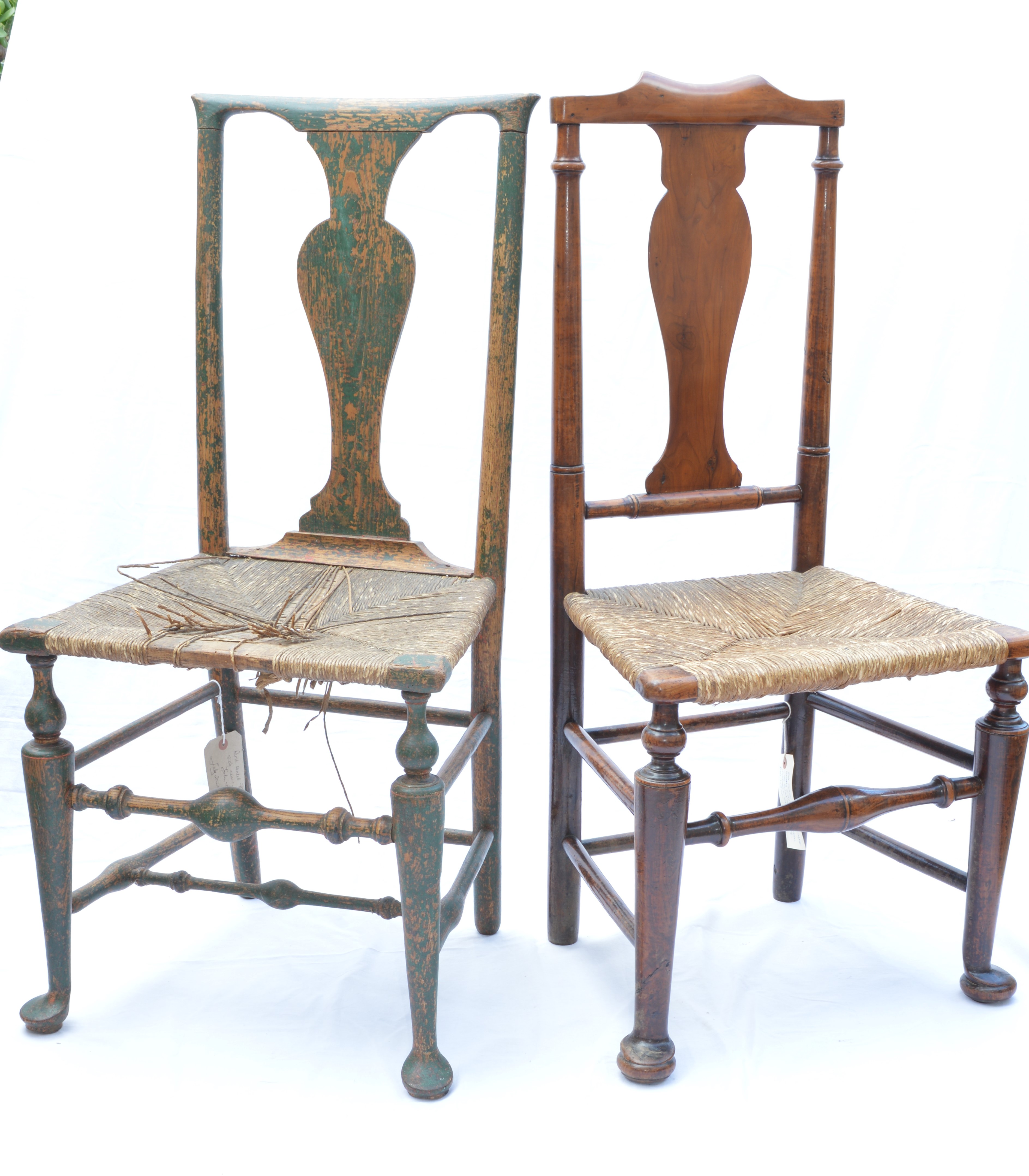
Please study the two rush seated chairs which I acquired at completely different times. The left hand one still has large areas of original green paint, very old rushing which has seen much use and a mixture of turned and shaped components. The front leg is rather well produced, with a pronounced offset turning to give a well defined foot. I have seen other similar front legs but had no idea where they were made, though I suspected it was somewhere close to Lincolnshire. 

The right hand chair was offered for sale at Golding Young in Lincoln during March 2023 and was knocked down to me for a hammer price of £75. I had not been to the viewings but I was delighted when I collected it next day, even the auctioneer commented that this well made chair had caught his eye. It had obviously come from a good home and been well cared for, being re-rushed a long time ago and well polished. The wood used was either cherry or some other fruit wood and judging by the craftsmanship that was employed to make the turned pieces, it had come from a very accomplished workshop. 

I will leave it up to the reader to assess the similarities between the two chairs.


One of the benefits of being a member of the Regional Furniture Society is that most other members are keen furniture historians. It was through the society that I meet Robert Williams, who lives just to the north of Cambridge and we have exchanged information on our respective regional chair collections over many years. A defining feature that he believes is common among his local chairs is the change in diameter of the back leg, above seat level. This is not a feature that I have ever seen on chairs that I associate with Lincolnshire rush seated chairs. He even has evidence to link this design pattern to Mendlesham in Suffolk. His immediate impression, when I shared some images with him, was that it indeed was from East Anglia.


© William Sergeant October 2023

Tuesday, 2 June 2020

Unusual Lincolnshire ladder back rush-seated side chair with 4 domed ladders with downward shaping, straight back poles, rushing bars, turned front legs morticed into the seat, two opposed-pear front stretcher almost never found in Lincolnshire, double side and rear stretchers WS 185

Unsual Lincolnshire ladder back rush-seated side chair with 4 domed ladders with downward shaping, straight back poles, rushing bars, turned front legs morticed into the seat, two opposed-pear front stretcher almost never found in Lincolnshire,  double side and rear stretchers WS 185
My talk at Spilsby in the spring of 2017 created much interest and it was during the public chair surgery the following day that I was told about this rush-seated chair that was in a church near Coningsby. When I was shown the photo that a member of the public had brought along, I was put in a quandary. The design was just so typical of a simple Lincolnshire rush-seated ladder back chair, remarkably similar to the chairs that I find in the south of the county. What puzzled me was the front stretcher with its double baluster or opposing pears. When I give talks, I point out that one of the defining features of a local rush-seated chair is that the front stretcher always has a single bulb in the centre so it became evident that I needed to see this chair for myself.

A few weeks later, I took my portable photographic studio to a small village on the edge of the Wolds (which I had never visited before) and found the church open. Like so many churches in this part of remote Lincolnshire, it is not used for regular services anymore though they are often open in the daytime. I found the chair next to the pedal organ in a very dirty, dusty and uncared for state, so I set about giving it a good clean and set up my studio to record it, the result of which you can see above.

Every component is of ash wood and original, generally in very good condition as it probably never gets sat on from one year to the next. I was unable to find anyone in the village who could give me any meaningful history of the chair .

I have no doubt that it was made locally and in future I shall have to modify what are the defining features of a rush-seated chair that was produced in the county.  Yet another example of the exception which proves the rule!


© William Sergeant 2017 and 2020

Tuesday, 7 April 2020

Lincolnshire rush-seated ladder back side chair, with plain stay rail attached to button finials of straight backpoles, 3 ladders, missing rushing bars, front stretcher with turnery commonly found in Lincolnshire, turned front legs morticed into the seat frame, with double side and rear stretchers

Lincolnshire rush-seated ladder back side chair, with plain stay rail attached to button finials of straight backpoles, 3 ladders, missing rushing bars, front stretcher with turnery commonly found in Lincolnshire, turned front legs morticed into the seat frame, with double side and rear stretchers WS 34
This an excellent example of a simple well made rush seated ladder back chair made out of ash (with rerushed seat). Vernacular furniture at its very best, probably made by the Ashton/Green families of the Spilsby, Alford, Louth area. This unloved chair appeared at a local auction house and was lotted with other house clearance bits which I got for a pittance - it should have been acquired by the local museum which is only a few streets away from where it was sold. The town where I bought it: Louth.

© William Sergeant 2012

Monday, 6 April 2020

Lincolnshire rush-seated ladder back side chair: straight back uprights with tapered feet & flattened top finials; 4 ladders with lower indented shaping; square cornered cabriole front legs morticed into the seat frame, missing rushing bars; front stretcher with turnery often found in Lincolnshire, double side & rear stretchers

Lincolnshire rush-seated ladder back side chair: straight back uprights with tapered feet & flattened top finials; 4 ladders with lower indented shaping; square cornered cabriole front legs morticed into the seat frame, missing rushing bars; front stretcher with turnery often found in Lincolnshire, double side & rear stretchers WS25
This is the very first rush seated Lincolnshire chair that I acquired; I found it hidden away in the back room of a second-hand shop in Greenwich. It was under other things and filthy but I recognised those distinctive front legs with cabriole shape and the turning on top. That was many years ago now and I am so pleased that I bought it. I think this is at least 200 years old; it has been made with a lack of sophistication and naivety that would indicate an early crude country chair - but what charm and presence!

© William Sergeant 2012

Sunday, 5 April 2020

Lincolnshire rush-seated ladder back side chair: straight back uprights with tapered feet & flattened top finials; 4 ladders with lower indented shaping; turned front legs with pad feet morticed into the seat frame, missing rushing bars; front stretcher with turnery often found in Lincolnshire, double side & rear stretchers

Lincolnshire rush-seated ladder back side chair: straight back uprights with tapered feet & flattened top finials; 4 ladders with lower indented shaping; turned front legs with pad feet morticed into the seat frame, missing rushing bars; front stretcher with turnery often found in Lincolnshire, double side & rear stretchers WS 23

Compare this Lincolnshire rush-seated side chair with WS 22 and WS21 below; there are so many things in common that these are undoubtedly made by the Ashton/Green families in North Lincolnshire. These do appear with much more regularity on the market and I have lost count the number of times they are described as Lancashire chairs. No, no, no, as a former Lincolnshire-born Prime Minister might have said. Look and learn! 

Lincolnshire rush-seated ladder back rocking chair: straight back uprights with flattened top finials; 4 ladders with lower indented shaping; turned front legs morticed into the seat frame, rushing bars; front stretcher with turnery often found in Lincolnshire, double side & rear stretchers WS 21

They are elegant well made vernacular furniture, skilfully made after many years of honing the design, cheap and light weight but brilliant survivors. They would have been on the market of their day as a cheaper alternative to Windsor chairs and many thousands of cottages in the East Midlands would have had these beautiful chairs to sit on.

© William Sergeant 2012 and 2020

Monday, 30 March 2020

A pair of Lincolnshire rush-seated bar top ladder back side chairs: straight back uprights with tapered feet & flattened stay rail fixed onto prominent button turnings; 3 plain domed ladders; straight turned front legs, morticed into the seat frame, missing rushing bars; front stretcher with turnery often found in Lincolnshire, double side & rear stretchers

A pair of Lincolnshire rush-seated bar top ladder back side chairs WS 100
A few months after I originally found WS 86 I was lucky enough to chance upon these two near identical chairs at the Newark Antiques fair in April 2013; they too are similar to figure NE 214 at p. 159 of Dr B D Bernard Cotton's The English Regional Chair (1990), chair which he attributes to South Lincolnshire. They are both in excellent condition and came a house clearance on the Nottinghamshire/Leicestershire border.  Well-worn front stretchers mean they have been well-used: they have been re-rushed some time ago but without their original rushing  bars being re-attached.

© William Sergeant 2013 and 2020

Saturday, 28 March 2020

Peter Tree discovering a front leg made from birch on a Lincolnshire rush-seated side chair

WS 60
The pair of chairs which appear in WS 59 had some wood in the front legs that I didn't recognise - one of the hall marks of a Lincolnshire rush seated chair is that they are invariably made out of ash. So the only thing to do was to pay a visit to my good friend Peter Tree: after some discussion in which we ruled out most woods we could think of Peter found his eyeglass and on closer inspection of the grain he established that the wood in question was in fact birch. It's not at all common in vernacular chairmaking to use birch in the UK but chairs that were imported from Scandinavian countries often were.

In July 2014 I was able to get Adam Bowett to look closely at this chair and he confirmed that it was in fact birch wood in the front legs.


© William Sergeant 2012


Update: further research has revealed that a number of Caistor chairs have birch components, including birch seats.  Since birch does not grow to seat-size dimensions in the UK we did a little more hunting and discovered that there were importations of American birch, which grows to a greater diameter, during the 19th century and quite possibly before that. Instances of birch cargos coming into the port of Hull have been found in advertisements in UK newspapers.

© William Sergeant and Julian Parker 2020

Thursday, 26 March 2020

Lincolnshire rush-seated bar top ladder back side chair: straight back uprights with tapered feet & flattened stay rail fixed onto prominent button turnings; 3 plain domed ladders; straight turned front legs, morticed into the seat frame, missing rushing bars; front stretcher with turnery often found in Lincolnshire, double side & rear stretchers


Lincolnshire rush-seated bar top ladder back side chair WS 86
Many thanks to Brian Gray for drawing my attention to this chair at a south Lincolnshire auction in 2013; I was away overseas and he kindly bought this one for me in my absence. These bar topped chairs are not common, in fact it's only the third one I have ever seen*. It's also the most simple of all the Lincolnshire rush-seated chairs: those front legs are as plain as can be with no pad feet or off-centre turning involved. In Dr B D Bernard Cotton's The English Regional Chair (1990) there is one very similar on page 159, figure NE 214. One of my neighbours brought a similar one at a south Lincolnshire  auction several years ago and images appear below: WS 5, 6 and WS 7:

Lincolnshire bar top rush-seated chair WS 5


Lincolnshire bar top rush-seated chair - detail of bar top stay rail and button turning WS 6

Lincolnshire bar top rush-seated chair - detail of front leg turning morticed into seat WS 7
*by January 2013

© William Sergeant 2020

Sunday, 22 March 2020

Lincolnshire child's originally rush-seated chair with 3 domed ladders front legs and underarm turned in one, turned arms, straight back poles with flattened finials

Lincolnshire child's originally rush-seated chair with 3 domed ladders front legs and underarm turned in one, turned arms, straight back poles with flattened finials
I have no doubt that this tiny child's chair came from the same workshop as that in WS 42. Just compare those front legs and the cross stretcher, there are even some scribe marks just beneath the front leg turnings which is typical of some  Lincolnshire workshops. However it has had a brutal past. It was once rush-seated but someone has taken away the rushing along with the rushing bars and replaced the seat with ply wood. The dealer still wanted a ridiculous price for it which I was not prepared to meet but at least I have recorded it here.  The chances are that I will probably never find another one like this.

P.S. I found out later that a dealer from Holland bought it, so it looks like it has gone overseas ...

P.P.S. UPDATE: By some strange quirk of fate this chair was offered for auction a few months later in Leominster! I wasn't going to miss it this time and I secured it for a very reasonable amount and was so pleased to add it to my collection. See WS 120 for comparison to other chairs.

© William Sergeant 2020

Lincolnshire rush-seated ladder back child's chair compared to ladder back rocking chair and ladder back side chair

WS 120: L-R WS 108 child's rush-seated chair, WS 42 rush-seated rocking chair of small proportions, and WS 59 RH full-size ladder back with pad feet

The child's chair is already featured in WS 108 but is compared here to two other chairs; it has replacement rushing bars but is the most delightful example of Lincolnshire regional furniture. The rocking chair with the missing lower ladder is also pictured elsewhere at WS 42. The full-sized rush-seated side chair on the right, from WS 59 is the most common design that I come across. While there are obvious design features that unite these three chairs,  there is also the fact that all have iron pins driven through from the back to secure the ladders into the back upright. Besides that all have faint scratch rings on the back legs to aid in their construction. All this leads to me to have no doubt that they all came from the same workshop.

© William Sergeant 2020

Thursday, 19 March 2020

Lincolnshire rush-seated ladder back armchair: 5 ladders with lower indented shape, straight back poles with flattened finials, front legs with graceful pad feet with upper turning joining the arms, Lincolnshire front stretcher turning, double side and rear stretchers

Lincolnshire rush-seated ladder back armchair WS 22
A Lincolnshire rush-seated ladder back similar, but not identical, to one that appears at figure NE189 on page 154 in Dr B D Cotton's The English Regional Chair (1990).  The front legs and turnings are very similar but the arms of NE189 are straight, whereas those in this chair curve and terminate in a flattened rounded saucer shape. This chair is taller and consequently has room for an extra ladder.

© William Sergeant and Julian Parker 2012 and 2020

Saturday, 30 November 2019

Lincolnshire Rush-seated Corner Chair corner chair, 3 straight backpoles, with pad feet, 2 splats, double Lincs front stretcher, double rear stretcher, double side stretchers, 3 part crest rail,

WS 69 Lincolnshire Corner Rush-seated Chair
This corner chair appeared in a Lincoln auction house in 2012. I studied it closely and was convinced it was a Lincolnshire chair the like of which I had never seen before. When it came to the auction someone else wanted it more than me, as I was left being the under-bidder. It was in fair condition and really should have spent the rest of its life in a museum in the county; I think I could search for many years and never see another: anyway we can all enjoy the image of it here. I sent a copy of this picture to Dr Bernard Cotton and he replied that this was the only Lincolnshire rush seated chair he had ever seen - it just makes me feel all the more foolish for not bidding higher.

© William Sergeant 2019

Monday, 4 November 2019

Lincolnshire rush-seated ladder back side chairs x 4, with straight backpoles with tapered feet & button finials, 4 ladders, domed with downward shape, rush bars, rush-seated, Lincolnshire front stretcher, double rear stretchers, double side stretchers, turned front legs & pad feet

WS 68 Lincolnshire rush-seated chairs, probably made by Ashton/Green
These four identical chairs appeared as one lot at the auction house in Ossett, South Yorkshire. They are in excellent condition with virtually no wear to the legs or stretcher at the front: they were sold to me for very little as no one else was interested in them. This design of Lincolnshire rush-seated chair is by far the most frequent; I would say that 50% of those I see are of this design; elegant, sturdy and beautifully crafted. I didn't keep these chairs but was happy to pass them on to a keen collector of all things from Louth as they were probably made by the Ashton/Green families around Louth. He also wanted to take Mr Muggins, the cat, but he is very valuable to me as he is in charge of vermin control around the farm buildings and I would not let him go!

© William Sergeant 2019

Lincolnshire rush-seated ladder back side chair, with straight backpoles with tapered feet & button finials, 4 ladders, domed with downward shape, rush bars, rush-seated, Lincolnshire front stretcher, double rear stretcher, double side stretchers, cabriole front legs & pad feet WS 66

Lincolnshire rush-seated ladder back side chair WS 66 
This is one of 4 identical chairs that were put up for sale at Criterion Auctions in Wandsworth; from the picture I guessed they were from Lincolnshire but the legs were not easily made out. It was not until several weeks later when they were delivered that the full extent of what I had bought became apparent. They are excellent chairs of a good age with front legs that I had not seen before and they do not appear in Dr Bernard Cotton's The English Regional Chair.  However, after I sent some pictures to Dr Cotton, he pointed out to me that the leg design is similar to the chair which was made about 1740 depicted on the front cover of his book which represented the height of fashion at that time. Perhaps the makers of this chair were using similar design features from more upmarket Windsor chairs on their humble chairs to raise the profile of them. This design also closely resembles that found on the chairs made by the cabinetmakers and chairmakers from Philadelphia in the early 18th century. Bearing in mind that the first Pilgrim Fathers left England from Boston in Lincolnshire it is perhaps not surprising that they may share a common heritage.


WS 65 Lincolnshire rush-seated chair legs compared

The left hand leg is from the chair in the photograph above and the other is from a classic Ashton/Green Lincolnshire rush-seated chair. Both are referred to as cabriole in shape and have turnings at the top but the left hand one has been shaped into an elegant style complete with a turned pad foot.

© William Sergeant 2019

Lincolnshire rush-seated ladder back side chair: straight back uprights with tapered feet & flattened top finials; 4 ladders with lower indented shaping; turned front legs of birch with pad feet morticed into the seat frame, with rushing bars; front stretcher with turnery often found in Lincolnshire, double side & rear stretchers

WS 60 Peter Tree, chair maker, discovers birch front legs

The pair of chairs which appear in this post had some wood in the front legs that I didn't recognise - one of the hall marks of a Lincolnshire rush seated chair is that they are invariably made out of ash. So the only thing to do was to pay a visit to my good friend Peter Tree: after some discussion in which we ruled out most woods we could think of, Peter found his eyeglass and on closer inspection of the grain he established that the wood in question was in fact birch! It's not at all common in vernacular chairmaking to use birch in the UK but chairs that were imported from Scandinavian countries often were. In July 2014 I was able to get Adam Bowett to look closely at this chair and he confirmed that it was in fact birch wood in the front legs.

© William Sergeant 2019

Monday, 7 October 2019

Clissett chair by John Warrender with board seat, 4 spindles within back bars, curved back uprights, shaped front rail, ring-turned front legs (which are slightly higher than the seat)

WS 154 Clissett chair by John Warrender

WS 155 John Warrender I*W stamp

These chairs are easily recognisable as Philip Clissett and members of his family made them for many years in the nineteenth century in and around Herefordshire. I came across a set of three while at the Newark Antique fair and was struck by their excellent condition. I really had no intention of buying them until I noticed some impressed initials at the top of the back legs; I pointed them out to the dealer but he was not in the slightest bit bothered. The letters were quite clear: I*W but they meant nothing to me so I sent an email to Terry Rowell who runs the Philip Clissett website. A short while later he contacted me to say the initial stood for John Warrender, a chairmaker from Worcestershire who was an uncle of Philip Clissett's, and the signed chairs were uncommon. The price was negotiated and I was happy to leave the fair with something, as I had not come across a single chair that could be associated with Lincolnshire.

Lower picture shows the impressed initials of John Warrender on the top of the back leg of chair No 154. He lived and worked in the village of Bransford, Worecesterchire . There is really no need for me to print anything else here but recommend you to visit Terry Rowell's  excellent Philip Clissett website website. You will find everything you need to know about him and his family.

© William Sergeant 2019

Rush-seated Dales chair with 3 spindles between back bars, straight back poles and front legs (which are slightly higher than the seat), regional turnery device on front stretcher, double side stretchers

WS 156 Rush-seated Dales chair

This chair came with the Clissett type chairs so in effect I got four chairs for the price of three. I recognised it as what Cotton describes in his book as a "Dales" chair from the Lancashire/Cumbria region. There were several features that struck me about this chair as it was probably the first time that I had handled one of these chairs. I was initial surprised how heavy it was along with being very well made. It is all ash construction with its original rush seat that had been painted a dark brown colour.

The two horizontal rails securing the upright turned back spindles are not turned but flattened and rectangular in section. You will notice that the front legs terminate just above the seat level - a feature that I never associate with the Lincolnshire rush seated chairs.
For similar chairs, see Dr B D Cotton The English Regional Chair (1990) NW 30, NW 31 and NW 32, p.330.

© William Sergeant 2019