Showing posts with label plain back. Show all posts

Tuesday, 20 April 2021

Lincolnshire bow back stick back Windsor armchair, 8 long sticks, 6 short, turned underarm supports, straight seat sides, ring and cove turned front legs with lower ring, H stretcher with 6 round bobbins, stamped MARSH, from the workshop of MARSH SLEAFORD


Lincolnshire bow back stick back Windsor armchair, 8 long sticks, 6 short, turned underarm supports, straight seat sides, ring and cove turned front legs with lower ring, H stretcher with 6 round bobbins, stamped MARSH, from workshop of MARSH SLEAFORD; front view

This chair turned up in a south Lincolnshire auction in October 2020: even were it not stamped 'MARSH', there are several features which point to Thomas Marsh and his son James. That linked post, which has more biographical details about Thomas (1777 or 1779-1844) and James (1803 - 1870) shows a stamped side chair with the 6 bobbin stretcher. Marsh is the only workshop stamp that has been found with such a stretcher.

Lincolnshire bow back stick back Windsor armchair, 8 long sticks, 6 short, turned underarm supports, straight seat sides, ring and cove turned front legs with lower ring, H stretcher with 6 round bobbins, stamped MARSH, from workshop of MARSH SLEAFORD; 3/4 view

Lincolnshire bow back stick back Windsor armchair, 8 long sticks, 6 short, turned underarm supports, straight seat sides, ring and cove turned front legs with lower ring, H stretcher with 6 round bobbins, stamped MARSH, from workshop of MARSH SLEAFORD; side view

The small chamfer at the end of the terminals of the arm bow is another characteristic Marsh workshop feature. The circular scribe line just visible on the side stretchers to mark the junction point with the cross stretchers is another Marsh workshop habit.


Lincolnshire bow back stick back Windsor armchair, 8 long sticks, 6 short, turned underarm supports, straight seat sides, ring and cove turned front legs with lower ring, H stretcher with 6 round bobbins, stamped MARSH, from workshop of MARSH SLEAFORD; rear view

Another Marsh workshop practice was to pin some of the long sticks with small square wooden pins from the rear of the bows: this chair has two such pins to secure 2nd and 7th long sticks to the back bow, 3 sets of holes for two more, missing the pins, on the 3rd and 6th long sticks (1st at the top in the back bow, 2nd in the arm bow and 3rd in the seat), two more, still with pins, to secure the back bow to the arm bow, and finally 4 more holes, two in the back bow and two in the seat, which appear to have been drilled in the wrong place as they do not align with any of the long sticks, unlike their companions. A momentary lapse of concentration on a Friday afternoon, perhaps.


Lincolnshire bow back stick back Windsor armchair, 8 long sticks, 6 short, turned underarm supports, straight seat sides, ring and cove turned front legs with lower ring, H stretcher with 6 round bobbins, stamped MARSH, from workshop of MARSH SLEAFORD; view from above

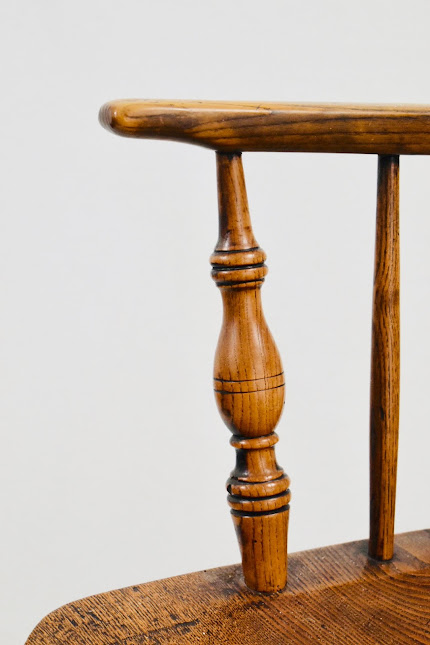
Lincolnshire bow back stick back Windsor armchair, 8 long sticks, 6 short, turned underarm supports, straight seat sides, ring and cove turned front legs with lower ring, H stretcher with 6 round bobbins, stamped MARSH, from workshop of MARSH SLEAFORD; detail of arm turning

Lincolnshire bow back stick back Windsor armchair, 8 long sticks, 6 short, turned underarm supports, straight seat sides, ring and cove turned front legs with lower ring, H stretcher with 6 round bobbins, stamped MARSH, from workshop of MARSH SLEAFORD; view from below with detail of leg turnings and stretchers

 
Lincolnshire bow back stick back Windsor armchair, 8 long sticks, 6 short, turned underarm supports, straight seat sides, ring and cove turned front legs with lower ring, H stretcher with 6 round bobbins, stamped MARSH, from workshop of MARSH SLEAFORD; detail of stamp.

The top part of each letter of 'MARSH' is just visible at the back of the seat. There does not appear to be any sign of the 'SLEAFORD' stamp that appears on some Marsh chairs. A pair of side chairs, one of which was exhibited at the exhibition in Alford in 2019 has 'MARSH' stamped on one seat and 'SLEAFORD' on the other. All parts of this chair are of ash.

© Julian Parker 2021

Friday, 16 April 2021

Lincolnshire bow back spindle back armchair stamped WILSON GRANTHAM, with 8 long spindles, 6 short, turned underarms, straight seat sides, ring and cove front leg turnings, plain back legs, H stretcher with darts


Lincolnshire bow back spindle back armchair stamped Wilson Grantham, with 8 long spindles, 6 short, turned underarms, straight seat sides, ring and cove front leg turnings, plain back legs, H stretcher with darts, 3/4 view


Lincolnshire bow back spindle back armchair stamped Wilson Grantham, with 8 long spindles, 6 short, turned underarms, straight seat sides, ring and cove front leg turnings, plain back legs, H stretcher with darts, view from above
Lincolnshire bow back spindle back armchair stamped Wilson Grantham, with 8 long spindles, 6 short, turned underarms, straight seat sides, ring and cove front leg turnings, plain back legs, H stretcher with darts, detail of arm turning 

Lincolnshire bow back spindle back armchair stamped Wilson Grantham, with 8 long spindles, 6 short, turned underarms, straight seat sides, ring and cove front leg turnings, plain back legs, H stretcher with darts, side view

Lincolnshire bow back spindle back armchair stamped Wilson Grantham, with 8 long spindles, 6 short, turned underarms, straight seat sides, ring and cove front leg turnings, plain back legs, H stretcher with darts, rear view

Lincolnshire bow back spindle back armchair stamped Wilson Grantham, with 8 long spindles, 6 short, turned underarms, straight seat sides, ring and cove front leg turnings, plain back legs, H stretcher with darts, stamp


For a short piece about John Wilson (1779 - 1837) see this post.

© Julian Parker 2021

Saturday, 13 February 2021

Vale of York compound-bent bow back armchair, with 7 long sticks, 8 short, turned underarms, turned front legs, plain back legs and H stretcher WS 217

Vale of York compound-bent bow back armchair, with 7 long sticks, 8 short, turned underarms, turned front legs, plain back legs and H stretcher  WS 217

A few years ago, I quite accidentally became acquainted with a retired antique dealer who lived in a fine Georgian town house in Grantham. I was fascinated by his tales of seeking out items of furniture in Lincolnshire and South Yorkshire and then often selling them on to the London trade during the 1960's & 70's. However, he had kept several choice items for his own house and he kindly allowed me to take some of them back to my photographic studio to record them. The image above is one chair from his small collection.

You will immediately see that I have taken the picture above from the side and I have done so for a very good reason: it clearly shows the compound bend in the steam bent back bow. There is no record of this technique being used by the Lincolnshire & Nottinghamshire chairmakers but I knew exactly where it had been made as soon as I saw it: namely in the Vale of York. I knew this because I had read an article by Adam Bowett that appeared in the Regional Furniture 2004. 


Front view WS 217

The house in Grantham has now been sold along with its contents and I am just so pleased that I had the enormous pleasure of meeting this gentleman and also being able to record so many of his fine vernacular chairs. This one appears to have every component made from ash wood with the legs through morticed and wedged into the seat. The design is not the most elegant that I have ever seen but it does have huge amounts of rustic charm.


The photo details above show that these images were taken in September 2015 and why they have been on my computer hard drive for over 5 years without being published is hard to explain. It is a great example of true vernacular furniture, such a recognisable design and a tribute to the craftsmen of Yorkshire. Since I took this picture, I must have seen at least half a dozen being offered for sale, mainly through Yorkshire auction houses and not one has ever mentioned Bowett's article and their association with the county.


Short sticks through-mortised and wedged from above WS 217

Underarm turning WS 217

Front leg turning WS 217


© William Sergeant 2021


Thursday, 18 June 2020

Lincolnshire comb back armchair by Marsh Sleaford, with curved crest rail, with 8 long spindles, the outer of which are turned stiles above the arm bow, which is chamfered at its ends, 6 short spindles, turned underarms, straight seat sides, ring and cove front leg turnings with 1 lower ring, plain back legs, H stretcher with darts WS 208

Lincolnshire comb back armchair by Marsh Sleaford, with curved crest rail, with 8 long spindles, the outer of which are turned stiles above the arm bow, which is chamfered at its ends, 6 short spindles, turned underarms straight seat sides, ring and cove front leg turnings with 1 lower ring, plain back legs, H stretcher with darts WS 208
This comb back Lincolnshire armchair is from the wonderful collection of former Regional Furniture Society member, James Drake. I was delighted when he said that I could include it here, as it's so important and you all will be able to appreciate it. It has an impressed name stamp towards the rear of the upper surface of the seat which reads MARSH, so from the workshop of father and son, Thomas and James Marsh of Sleaford. The legs and underarm turned supports are typical of their patterns but the chair is of overall compact proportions, the like of which I have never seen before. The particular pleasing feature are the two outside long back support spindles (stiles), which start at the seat level and pass through the armbow the continue with the decorative turning up to the back comb, an elegant touch. This could easily become my favorite Lincolnshire armchair.

© William Sergeant 2019

Wednesday, 17 June 2020

Lincolnshire low bow back Windsor armchair, probably Hubbard Grantham, with 5-piercing fleur de lys and teardrop piercing splat, 6 long spindles, 8 short, crook underarms, straight seat edges, ring and cove front leg turnings with 1 lower ring, plain back legs, crinoline stretcher WS 201

Lincolnshire low bow back Windsor armchair, probably Hubbard Grantham, with 5-piercing fleur de lys and teardrop piercing splat, 6 long spindles, 8 short, crook underarms, straight seat edges, ring and cove front leg turnings with 1 lower ring, plain back legs, crinoline stretcher WS 201
The low profile of the back bow gives this chair a distinctive squat appearance, like no other Lincolnshire chair that I can think of. I knew that they existed as a signed pair are illustrated in published works on vernacular furniture but I had been waiting for years for one to appear on the open market so that I could add it to my collection. It was offered for sale in a Shropshire sale room, with a good description and photos, so I bid with confidence and secured its purchase. After a couple of months the chair was delivered to my home and I was delighted with the overall condition. The seat is of elm, while all other components are made from yew wood with the back legs of ash; a typical combination that is so often found in Lincolnshire best chairs. It has one feature that is so rare on chairs made in the county, that is the incised scratch mark around the edge of the back bow.

This chair is not stamped by the workshop owner but the two that appear in Dr B D Cotton's The English Regional Chair (1990) at figures NE24 and NE25 on p. 118 were stamped clearly HUBBARD GRANTHAM, so I am in no doubt that this chair was produced in the workshop of Richard Hubbard of Little Gonerby about 1807 - 1820.

© William Sergeant 2019

Tuesday, 16 June 2020

Lincolnshire hoop back Windsor side chair, Marsh of Sleaford, with 7 long spindles, bell-shaped seat, ring and cove front legs with 1 lower ring, plain back legs, H stretcher with darts WS 106

Lincolnshire hoop back Windsor side chair, Marsh of Sleaford, with 7 long spindles, bell-shaped seat, ring and cove front legs with 1 lower ring, plain back legs, H stretcher with darts WS 106


See chair WS 92 - I just knew that I would find one of these chairs with a stamp of the maker on it . This one turned up on eBay along with 3 other chairs at the very northern edge of the county of Lincolnshire. I won the bidding and was delighted to find on collection that this one was clearly stamped MARSH SLEAFORD. A bit of polishing restored this fine chair to its full glory.


© William Sergeant 2018 and 2020

Monday, 15 June 2020

Lincolnshire hoop back Windsor side chair, probably by Marsh of Sleaford, with 7 long spindles, bell-shaped seat, ring and cove front legs with 1 lower ring, plain back legs, H stretcher with darts WS 92

Lincolnshire hoop back Windsor side chair, probably by Marsh of Sleaford, with 7 long spindles, bell-shaped seat, ring and cove front legs with 1 lower ring, plain back legs, H stretcher with darts WS 92
This chair was consigned to a regular house clearance sale in Grantham and didn't even get considered for the better antiques sale.  Although there is no maker's stamp to be found on it, there are however tell-tale signs all over it which makes me believe that it was made by Thomas or James Marsh in Sleaford. There are a whole load of features that they used: darts at the either end of the cross stretcher; scratch markers on the side stretchers for the drilling of holes; thicker front leg ; thicker seats which sweep out at the front; carefully selected wood for the legs with no wild grain; tiny square sprigs driven into the back of the bow to secure the middle and two outside back spindles and finally the distance between the upper and lower rings on the front legs are always identical. Everything about their chairs was just that bit better than anything produced in the neighbouring town of Grantham. PS: after a recent visit from Bill Cotton, I can confirm what I had thought for a while: that the seats of Marsh chairs are usually made out of ash wood, as is the case here.

© William Sergeant 2018 and 2020

Friday, 12 June 2020

Medium bow back Lincolnshire Windsor spindle back armchair stamped AMOS GRANTHAM, with 9 long spindles, 8 short, crook underarms, straight seat sides, ring and cove front leg turnings, with 1 lower ring, plain back legs, H stretcher with darts WS 190 & WS 189

Medium bow back Lincolnshire Windsor spindle back armchair stamped AMOS GRANTHAM, with 9 long spindles, 8 short, crook underarms, straight seat sides, ring and cove front leg turnings, with 1 lower ring, plain back legs, H stretcher with darts WS 190
This is a typical early Lincolnshire windsor armchair. Plain back legs with the front ones having the design of a thin ring above an exaggerated shallow cove, an all-spindle back support and curved underarm supports. This one has an ash seat with yew for the other components. I believe that this is the very essence of a chair that was made in the first period of Windsor chairmaking in the county, namely 1800-1812. 

The name stamp on the edge of the seat is AMOS GRANTHAM, so we know exactly in whose workshop it was made. It came from a house just outside Newark and it had been in the family for many years. It was in a slightly distressed state when I brought it at auction but I got a restorer to make it usable again.

John Amos was a wheelwright and as such ran a business for the first 15 years of his working life making wagons and carts for farmers and merchants as well as servicing ones that were already in use. It was not until 1809 that the first advert by him was posted in the paper searching for journeymen chairmakers. All of the chairs that I have seen from his workshop are of the second period type, which I believe started to be produced in about 1812 but I was not surprised to seen this design by him. This leads me to think that this chair was probably made in the first 3 years of his manufacture, namely 1809-1812.


Bench holdfast marks on medium bow back Lincolnshire Windsor spindle back armchair WS 190 stamped AMOS GRANTHAM WS 189
This picture shows part of the underside of the armbow of this AMOS chair. You can see quite clearly the small areas of cross-hatching that are impressed into the surface of the wood. This was caused by bench holdfasts. These have been used by woodworkers since ancient times and are used, as their name suggests, to hold a piece of wood firmly to the workbench. They are the shape of a swan's neck, with the neck part slipped down a hole in the bench and the crooked head part tapped with a mallet to spread the bend and hold the wood secure. They can easily be released with a sideways tap. 

For the holdfast to grip the wood better, there is cross-hatching filed into the end. This is what has left the marks above. The length of yew wood would be soften in the steam box and the placed against the profile form that it is to be moulded around and once bent, it is held firmly in place while it cools by a series of holdfasts. 


© William Sergeant 2017 and 2020

Thursday, 11 June 2020

Medium bow back Lincolnshire Windsor armchair stamped BRAND SLEAFORD with 9 long spindles, 8 short, turned underarms supports, bell-shaped seat, 2 ring and cove legs with 2 lower rings, plain back legs, crinoline stretcher, WS 192/199

Medium bow back Lincolnshire Windsor armchair stamped BRAND SLEAFORD with 9 long spindles, 8 short, turned underarms supports, bell-shaped seat, 2 ring and cove legs with 2 lower rings, plain back legs, crinoline stretcher, WS 192/199
At first glance this is a typical Lincolnshire spindle back Windsor armchair. It is stamped BRAND SLEAFORD. The solid thick seat is fashioned from elm, the front legs are made out of cherry and the back legs turned from ash. Every other component is made from yew wood. What makes this chair slightly unusual is the turnery design to the front legs - the element of added decoration. There is a double ring turning above the cove and towards the base of the leg the turnery design is a double ring again. This striking feature is almost identical to the Shirley chair in WS 198.

Chairs by this maker are very rare. This one is the first that I have handled after many years of searching and I was pleased to add it to my collection. I had come across John Brand before - see WS 163 and 164. 
That chair with the seat stamped BRAND and MARSH proves that they must have been working together for a while.

The tradition of chair making in Sleaford has three names which standout and often appear in the directories and censuses, namely MARSH, BRAND and MASON. While many MARSH stamped chairs have been recorded, very few BRAND stamped chairs appear on the market and not one single chair stamped with MASON has ever been found.  After many years of searching, I was so pleased to find this BRAND chair advertised on the internet by a dealer in the south of the county. We agreed on a price and as he was about to visit the Newark Fair, he offered to deliver it as well.

© William Sergeant 2017 and 2020

Tuesday, 9 June 2020

Thomas Simpson, Boston stamped high bow back Lincolnshire Windsor armchair with 5-piercing fleur de lys upper splat, double pierced lower splat, crook underarm supports, 2 x 3 long spindles, 2 x 3 underarm spindles, ring and cove front leg turnings & plain back legs, crinoline stretcher WS 207

Thomas Simpson, Boston stamped high bow back Lincolnshire Windsor armchair with 5-piercing fleur de lys upper splat, double pierced lower splat, crook underarm supports, 2 x 3 long spindles, 2 x 3 underarm spindles, ring and cove front leg turnings with lower ring & plain back legs, crinoline stretcher WS 207
Another chair from the collection of James Drake, this time a yew wood chair with reduced legs, but stamped clearly on the edge of the seat: T SIMPSON & Co BOSTON. There is another Simpson Windsor armchair at WS 123, and if you compare the back splat of both, I think that you would agree with me that both were made from the same master pattern, with the main difference being that this chair has a crinoline stretcher whereas WS 123 has an H stretcher with darts.

© William Sergeant 2020

Monday, 8 June 2020

Medium bow back Lincolnshire Windsor armchair stamped TAYLOR GRANTHAM, turned underarm supports, 8 long spindles, 2 x 3 underarm spindles, ring and cove front leg turnings with single lower ring & plain back legs, H stretcher with cross stretcher turned with darts WS 85

Medium bow back Lincolnshire Windsor armchair stamped TAYLOR GRANTHAM, turned underarm supports, 9 long spindles, 2 x 4 underarm spindles, ring and cove front leg turnings with single lower ring & plain back legs, H stretcher with cross stretcher turned with darts WS 85
I happen to find this one at the Newark Antiques Fair and I was convinced it was made by Marsh of Sleaford but on close inspection there is a faint stamp on the rear of the seat which says TAYLOR GRANTHAM. Fortunately no one had noticed this maker's mark and it joined my collection for a very small fee. The underarm turnings are so similar to Marsh of Sleaford that only when they are stood next to each other can you spot the differences. Compare this chair with WS 29 and you will see what I mean.

Other differences are that Taylor has 8 long spindles and 6 short, whereas Marsh uses 9 long and 8 short; Marsh puts a slight chamfer on the underside of the end of the arm bow, absent from the Taylor chair. The ring on the front legs of the Taylor chair is slightly deeper than that on the Marsh.

© William Sergeant 2018 and Julian Parker 2020 

Sunday, 7 June 2020

Lincolnshire medium bow back Windsor armchair, stamped I * TAYLOR GRANTHAM with 9 long spindles, 8 short, crook underarms, bell-shaped seat, ring and cove turned front legs with 1 lower ring, plain back legs, crinoline stretcher WS 211

Lincolnshire medium bow back Windsor armchair, stamped I * TAYLOR GRANTHAM with 9 long spindles, 8 short, crook underarms, bell-shaped seat, ring and cove turned front legs with 1 lower ring, plain back legs, crinoline stretcher WS 211
Regular students of Lincolnshire Windsor chairs will have seen the image of this chair before. It is simply remarkable. It appears on p. 138 of Thomas Crispin's The English Windsor Chair (1992) and again in Dr B D Cotton's The English Regional Chair (1990) at figure NE12 on p. 113. Both books show the name stamp of I*TAYLOR which relates to the eldest son of Roger and Sophia Taylor, one John Taylor. Those of you who have seen my lecture at Conway Hall on Youtube will know that he made chairs for only three years, from February 1808 until January 1811, after which he became a mail coach guard for 31 years. The only other recorded I*TAYLOR stamped chair passed through the now closed auction room of Neale's of Nottingham in 2002. 


Detail of upper rear of seat of Lincolnshire medium bow back Windsor armchair, stamped I * TAYLOR GRANTHAM


WS 204 on the left, WS 211 on the right

You may also wish to compare this chair to yesterday's post WS 204, which has no makers mark, but I am sure both were made by the same hand.

The extraordinary fact is that this chair appeared on eBay recently and was spotted by a fellow enthusiast (one Julian Parker) who kindly notified me. The young lady in London selling the chair had seen the name stamp but had been unable to decipher the name. She had acquired the chair off Greenwich market at least 15 years before, besides that there was no other provenance.


© William Sergeant and Julian Parker 2020


Saturday, 6 June 2020

Lincolnshire medium bow back Windsor armchair, with 9 long spindles, 8 short, crook underarms, bell-shaped seat, ring and cove turned front legs with 1 lower ring, plain back legs, crinoline stretcher WS 204

Lincolnshire medium bow back Windsor armchair, with 9 long spindles, 8 short, crook underarms, bell-shaped seat, ring and cove turned front legs with 1 lower ring, plain back legs, crinoline stretcher WS 204
My attention was drawn to this chair, that was advertised on Instagram, by my fellow furniture enthusiast Tim Garland. From the image by the vendor, it was obvious that it was in poor condition with some serious structural issues - also it was said to be possibly from Welsh borders. I recognised it as a typical early spindle back Lincolnshire Windsor armchair, dating from about 1815. There was no indication whether it was marked by the workshop owner. After having completing the deal, the chair duly arrived and the breakages were even worse than I had initially thought, but no matter, as it was soon in the capable hands of Tim. He repaired and restored the chair and the result can be seen in the picture above. He made a splendid job, and we both felt a deep sense of satisfaction of having rescued a valuable historical piece of vernacular furniture.

The maker of this chair remained a mystery to me, but as you may have heard me say before, the maker always leaves his finger prints all over his chairs, if you just know where to look. The give away was the incised ring around the back legs to indicate where the hole needed to be drilled to take the side stretcher. The only signed chairs, that have this feature, are those that are signed TAYLORS, so those made in the workshop of William Taylor. There remains the possibility that those made in his brother's workshop (John), could have the same implicit mark but as I had never handled one, and am most unlikely ever to find one, so the final identity of the marker remains uncertain.


© William Sergeant 2019

Saturday, 30 May 2020

2 x Lincolnshire comb back Windsor side chairs by Marsh Sleaford with curved crest rail, turned stiles, 5 long spindles, straight seat sides, ring and cove front leg turnings with 1 lower ring, plain back legs, H stretcher with 6 bobbin turning, H stretcher with darts WS 176

2 x Lincolnshire comb back Windsor side chairs by Marsh Sleaford with curved crest rail, turned stiles, 5 long spindles, straight seat sides, ring and cove front leg turnings with 1 lower ring, plain back legs, H stretcher with 6 bobbin turning on left, H stretcher with darts on right, WS 176
Two complementary beautifully balanced Lincolnshire Windsor side chairs by Thomas or James Marsh of Sleaford. Their turning and proportions stand out amongst Lincolnshire makers.

Angled view of Lincolnshire comb back Windsor side chair by Marsh Sleaford with curved crest rail, turned stiles, 5 long spindles, straight seat sides, ring and cove front leg turnings with 1 lower ring, plain back legs, H stretcher with 6 bobbin turning 


© William Sergeant and Julian Parker 2020 

Tuesday, 26 May 2020

Lincolnshire comb back rocking side chair with turned stiles, 6 long spindles, straight seat sides, ring and cove front leg turnings with 1 lower ring, plain back legs, H stretcher WS 93

Lincolnshire comb back side rocking side chair WS 93
From the collection of Steven Voyt. This the first Lincolnshire side chair on rockers that I have ever seen. On close inspection it appears to be all original and genuine. Although it is unstamped,  just compare the turned back supports with WS 90, which is stamped Camm Grantham.  I think the two chairs are near enough identical to say that they were made in the same workshop. The major difference between the two is in the front leg design: while this one has two rings WS 90 has a ring and a cove; this would indicate a subtle change with time: the two ring design being recognised as coming later than the ring and cove.

© William Sergeant 2013 and 2020

Sunday, 24 May 2020

Lincolnshire comb back side chair stamped Camm Grantham with turned stiles, 6 long spindles, straight seat sides, ring and cove front leg turnings with 1 lower ring, plain back legs, H stretcher WS 90

Lincolnshire comb back side chair stamped Camm Grantham with turned stiles, 6 long spindles, straight seat sides, ring and cove front leg turnings with 1 lower ring, plain back legs, H stretcher WS 90
Whilst visiting other peoples houses I have poor manners. I pay far too much attention to their furniture, particularly their chairs. On a previous visit to a house in the village of Navenby, I had spotted what looked like some Lincolnshire side chairs nestling under the kitchen table. On my most recent visit (2013) I was allowed closer inspection of the same and to my surprise and joy one of them was impressed with the maker's name : CAMM GRANTHAM. What a find! As far as I am aware there has been no record of a stamped comb back side chair by this maker although a quick search of Dr B D Cotton's The English Regional Chair (1990) shows a near identical chair stamped  J HILL (figures NE 104 and NE 105 on p. 134 ). Where is Navenby? It's north of Grantham on the road to Lincoln.

© William Sergeant 2013 and 2020

Saturday, 23 May 2020

Medium bow back Windsor armchair stamped Camm Grantham, with 8 long spindles, 6 short, turned underarm supports, straight seat sides, ring and cove turned front legs with 1 lower ring, plain back legs, H stretcher WS 95

Medium bow back Windsor armchair stamped Camm Grantham, with 8 long spindles, 6 short, turned underarm supports, straight seat sides, ring and cove turned front legs with 1 lower ring, plain back legs, H stretcher WS 95
In the collection of Steven Voyt. Purchased in Grantham, this bow back spindle back Windsor armchair  probably has never travelled far, as it was made in Grantham. Two more chairs made by Camm can be seen at WS 12 and WS 13, the underarm supports and legs of which could be swapped with this chair and no one would spot the difference, which reinforces the fact that individual makers had their own design features and reproduced them over and over again.

© William Sergeant 2013 and 2020

Friday, 22 May 2020

Comb back Lincolnshire Windsor armchair probably Camm Grantham with curved crest rail, turned stiles, 8 long spindles 6 short, turned underarm supports, straight seat sides, ring & cove turned front legs with 1 lower ring, H stretcher WS 12

Comb back Lincolnshire Windsor armchair probably Camm Grantham with curved crest rail, turned stiles, 8 long spindles 6 short, turned underarm supports, straight seat sides, ring & cove turned front legs with 1 lower ring, H stretcher WS 12
An unstamped comb back Windsor armchair from Grantham, identical to this stamped chair by Thomas Camm of Grantham. I had missed the stamped one at the auction in Buckinghamshire but I had taken many pictures for my own records so when this little beauty turned up at a Cambridgeshire auction unstamped and unloved I was certain who made it. I compared individual turnings side by side on the computer - they could have been made the same week from the Grantham workshop of Thomas Camm. It came home with me for a very reasonable price!

© William Sergeant 2012 and 2020

Thursday, 21 May 2020

Comb back Lincolnshire Windsor armchair stamped Camm Grantham with curved crest rail, turned stiles, 8 long spindles 6 short, turned underarm supports, straight seat sides, ring & cove turned front legs with 1 lower ring, H stretcher WS 13

Comb back Lincolnshire Windsor armchair stamped Camm Grantham with curved crest rail, turned stiles, 8 long spindles 6 short, turned underarm supports, straight seat sides, ring & cove turned front legs with 1 lower ring, H stretcher WS 13
A comb back Windsor chair, stamped on the seat edge: Camm Grantham. This identifies the maker's workshop as Thomas Camm of Grantham, working about 1825.  This one turned up in an evening auction in Buckinghamshire and I travelled down to view: it was from a house clearance and in excellent condition. When the auction got under way there were very few people in the room and the auctioneer struggled to get bids on anything. The moment arrived for this lot. My hopes were sky high and heart beating fast: I started the bidding at a low amount and outbid a couple in the room; it was going to be mine for a modest sum; then came the moment I was fearful of: an anonymous phone bidder. Well, dear reader, you can imagine what happened next: I continued bidding but every time the phone outbid me. I went way over my limit to several hundred pounds but in the end I let it go. What disappointment! After that the auctioneer stopped the auction and asked me "What was that all about?" I explained that the chair really was the essence of Lincolnshire chairmaking and design, stamped by a maker who did not work for long in Grantham. He told me that the person on the phone was a London dealer who was known to him but had never shown an interest in chairs before. Well, he certainly had to pay a lot of money for it and good luck to him.

William Sergeant 2011 and 2020