Showing posts with label rush-seated. Show all posts

Tuesday, 31 October 2023

East Anglian chairs - WS 227


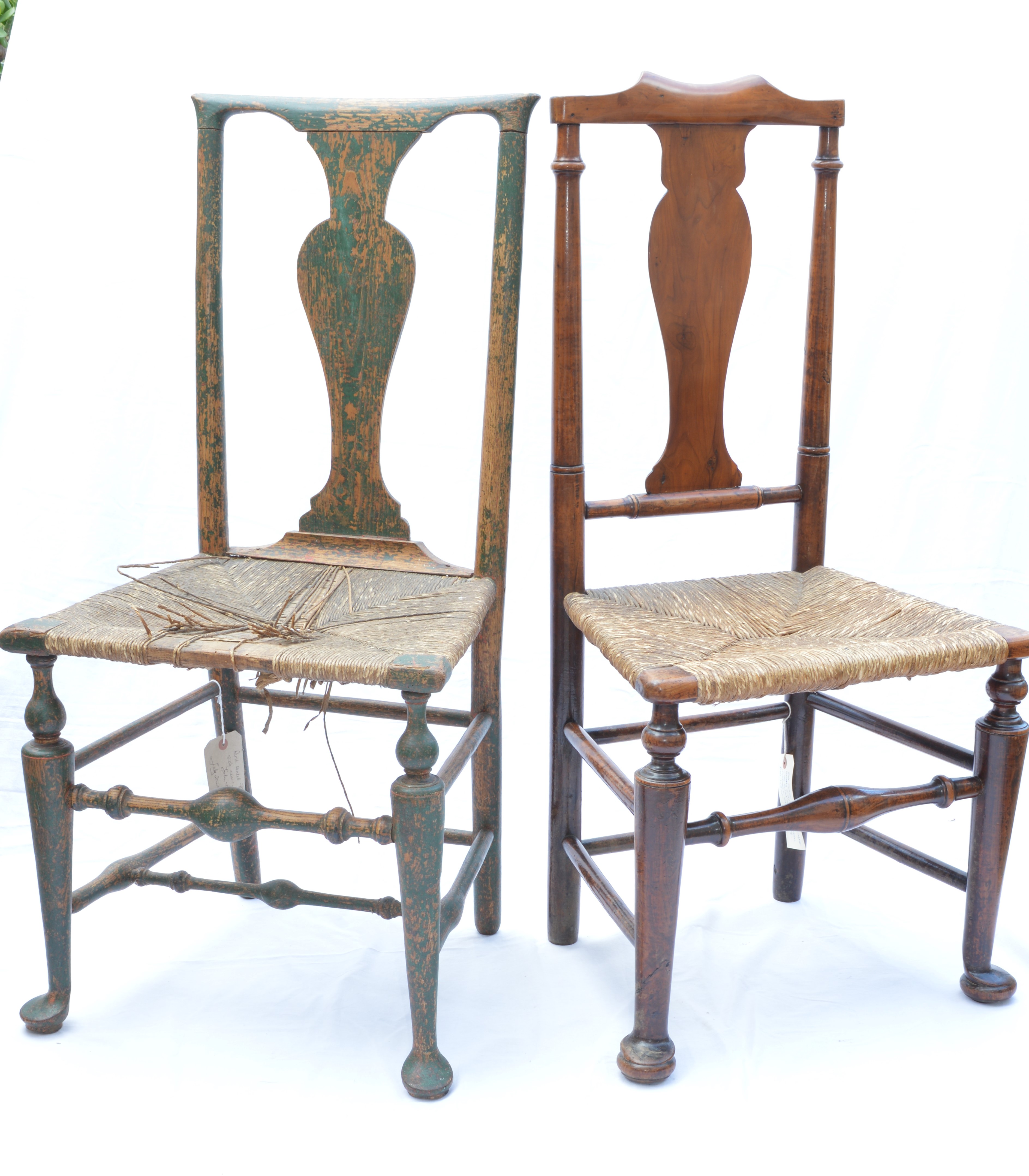
Please study the two rush seated chairs which I acquired at completely different times. The left hand one still has large areas of original green paint, very old rushing which has seen much use and a mixture of turned and shaped components. The front leg is rather well produced, with a pronounced offset turning to give a well defined foot. I have seen other similar front legs but had no idea where they were made, though I suspected it was somewhere close to Lincolnshire. 

The right hand chair was offered for sale at Golding Young in Lincoln during March 2023 and was knocked down to me for a hammer price of £75. I had not been to the viewings but I was delighted when I collected it next day, even the auctioneer commented that this well made chair had caught his eye. It had obviously come from a good home and been well cared for, being re-rushed a long time ago and well polished. The wood used was either cherry or some other fruit wood and judging by the craftsmanship that was employed to make the turned pieces, it had come from a very accomplished workshop. 

I will leave it up to the reader to assess the similarities between the two chairs.


One of the benefits of being a member of the Regional Furniture Society is that most other members are keen furniture historians. It was through the society that I meet Robert Williams, who lives just to the north of Cambridge and we have exchanged information on our respective regional chair collections over many years. A defining feature that he believes is common among his local chairs is the change in diameter of the back leg, above seat level. This is not a feature that I have ever seen on chairs that I associate with Lincolnshire rush seated chairs. He even has evidence to link this design pattern to Mendlesham in Suffolk. His immediate impression, when I shared some images with him, was that it indeed was from East Anglia.


© William Sergeant October 2023

Tuesday, 6 April 2021

Antonio Debertolis: an Austrian Chairmaker in Gippsland, Victoria, Australia: Terence Lane

Antonio Debertolis Memorial, Drouin Cemetery, Gippsland, Victoria


This article, which appeared in the Gippsland Heritage Journal No. 24 (2000) is reproduced with the kind permission of the author, Terence Lane, together with Linda Barraclough & Meredith Fletcher of the Gippsland Heritage Journal.

M. R. M. Smith, in his 1968 reminiscences of old Drouin, gives a tantalizing firsthand account of the Austrian chairmaker, Antonio Debertolis, who lived and worked in Drouin at the turn of the century:

One of our neighbours in these days was an elderly Italian, though he might have been a Greek, named Antonio Derbertolis (sic) (generally known as ‘Old Antoney’) who was a positive genius at manufacturing chairs and other household furniture out of blackwood (for the frames) and rushes for the seats, etc. The principal tool which I recall his using was a spokeshave with which he used to shape the wood, and I spent very many happy hours in his workshop watching him. He was a small man, somewhat stooped and bent, with curly hair going grey and with ear-rings in his ears - the ears were pierced, of course. My wife and I still have two of his chairs and a foot-stool which he made for my mother many years ago. In his work Antoney did not use screws, nails or glue and in their place wonderfully shaped wooded dowels held the frames together. The chairs which we have are very light in weight but very strong and never, in all the years we have had them, have the chairs or the foot­ stool required any attention by way of repairs, even though they have suffered some very hard use over the years from three generations of small children.1

Time has not been kind to Antonio Debertolis. His name was better remembered in the 1940s, ’50s and ’60s, and in more recent years he has posthumously suffered the indignity of having his chairs misattributed to a number of other makers. The tide appears to have turned, though, and in 1998 two of his chairs, together with a biographical outline, were correctly published in Kevin Fahy and Andrew Simpson’s definitive Australian Furniture: Pictorial History and Dictionary, 1788-19382

Antonio Debertolis was neither Italian nor Greek, as M.R.M. Smith suggested. He was in fact an Austrian, born in 1849 or 1850 in Tonadico, a village in the Dolomites, at that time in the southern region of the Austro-Hungarian Empire but now part of Italy. It is not known when or why he left Austria, but he arrived in the Colony of Victoria from Wellington, New Zealand, in March 1877. He was naturalised in 1893, his application stating that he was a labourer and that he had been living in Drouin for fifteen of his sixteen years in the Colony.3 In the years 1883-84, 1884-85 and 1885-86 he was registered as a ratepayer and occupier of 43 acres of Crown Land in the Parish of Drouin West,4 and in 1884-85 the Gippsland directory listed him as a farmer.5 Towards the end of his life he was living in Drouin, and the Warragul and District Historical Society has located his house, now demolished, in Young Street, on the outskirts of the town.6 When he died in February 1913 at the age of 63, his occupation was again given as ‘labourer’.7 He was a Roman Catholic and, apparently, a bachelor, and was buried in an unmarked grave in the Catholic section of Drouin Cemetery.8

The bare contemporary details of Debertolis’ life make no reference to his principal claim to fame, the craft of chairmaking that he must have practised on quite a scale during his years in Gippsland. His chairs belong firmly to what has been called ‘the Latin slat-back chair’9 tradition, the ‘open frame’ cottage chair idiom of the Mediterranean and other European countries, extending through colonization across the globe. The completeness with which Debertolis transferred the Austro/North Italian tradition to Gippsland is demonstrated by a comparison of one of his baluster-splat chairs (plate 1) with a chair of the same type and about the same date (plate 2) from the Treviso region of Italy, just a short distance from his birthplace. 

Plate 1: Debertolis chair, blackwood, c.1900.
Private collection, Melbourne.

Plate 2: Chair from Treviso region, c.1900.
Private collection, Treviso.

The similarities are striking, even down to the smallest details, such as the outswept top rail and the taper of the feet. This was the ancient craft of the rural or village chairmaker, before the production line and the division of labour - a craft that was completely transportable and, therefore, ideally suited to the itinerant or emigrant craftsman. Debertolis’ tools would have been of the simplest kind - an axe and saw for cutting timber in the bush, wedges and a mallet for cleaving it into manageable lengths, a drawknife or spokeshave for shaping the members, a drill and brace and bit for making rail and stretcher ends and sockets, and a knife for cutting rushes in the local creeks and swamps. There is no evidence that he owned anything as sophisticated as a lathe.

Debertolis chairs are always of blackwood, presumably ‘found’or cut green in the bush. Often he used the sapwood, which was lighter in density than commercial dressed timber and sometimes had a colourful striped appearance. The legs and uprights are generally square-in-section, and tapered, with chamfered edges. The stretchers and rails are usually round in section, either spokeshaved or made from saplings or thin branches, with natural bends and kinks, which would only have to be scraped of their bark. As M.R.M. Smith noted, Debertolis used no screws, nails and glue: slats were secured between rails or uprights with traditional mortise and tenon joints; arm posts, seat rails and stretchers were firmly held in sockets drilled right through the arm rests, legs and uprights rather than concealed; and wooden pegs reinforced the uppermost joints of those chairs with outswept top rails. Although seagrass seats are often found on Debertolis chairs, it seems that all his chairs were originally rush-seated. Excavated original seats have been found to be stuffed with blackwood chips and shavings.10

Five designs of Debertolis chairs, distinguished by the treatments oftheir backs, have been recorded. They are listed in order of rarity, from the most to the least common:

• Twin, opposing, triangular-shaped horizontal splats, pointing inwards, with the slats secured between the uprights. Types: chair, child’s chair and child’s high chair, (plate 3)

Plate 3: Debertolis chair, blackwood, c.1900.
Private collection, Melbourne.
• Thin, vertical slats, secured between the top rail and cross rail. Types: chair (three slats), child’s chair (three slats), armchair (four, five or six slats) and settle (seventeen slats), (plate 4)

Plate 4: Debertolis chair, blackwood, c.1900.
Powerhouse Museum, Sydney.
• Twin, opposing, serpentine, vertical slats, secured between the top rail and the cross rail. Types: chair and armchair, (plate 5)

Plate 5: Debertolis chair, blackwood, c.1900.
Private collection, Melbourne.

• Pierced baluster-shaped splat, secured between the top upright and cross rail. Types: chair (one splat) and settle (five splats).(plate 1)

• Ladderback, with horizontal slats secured between the uprights. Types: chair (three slats) and armchair (four slats).

One of Debartolis’ printed paper labels has survived (ANTONIO DEBERTOLIS/ Maker, Drouin/ Every Chair is Guaranteed for Rough Ware), and a rectangular white enamel label, with black lettering, has been sighted.11

The number of surviving chairs testifies to the strength of their construction and to a wide production. Debertolis apparently catered to both the Gippsland (local and tourist) and Melbourne markets - the latter supplied by the Malvern furniture dealer, E. J. Smith.12 Debertolis chairs no doubt found their way into many a Gippsland farmhouse, but also had a following in the towns, amongst the local gentry and in the metropolis. Without postulating a brilliant career for Debertolis - quite the opposite - he was in some ways the right man in the right place at the right time, in that rush-seated chairs of honest construction had been promoted internationally since the 1860s, when William Morris, the father of the Arts and Crafts Movement, launched his open­ framed, rush-seated ‘Sussex’ chairs as an alternative to the carved, veneered, French-polished and heavily upholstered contortions of ‘the Trade’. In the late 1880s Morris’follower, Ernest Gimson, revived another rustic classic, the rush-seated ladderback chair, which went on to become a staple of the turn of the century Arts and Crafts interior. The ’90s were the time of ‘the great cleanout’ of the cluttered, heavily upholstered and accessoried interiors of the late Victorian period. This decade also saw the awakening of interest in folk art, and the growing appreciation of traditional furniture forms. These European developments soon reached the design­ conscious elite in the Colonies, and by 1887 we find the author, Ada Cambridge, furnishing the St Kilda home of her Aesthetic heroine with rush-seated chairs, in her story, ‘Human Perversity’.13 The cabinet maker and art furnisher must have been pleased to know that they only had to run down to Mr Smith’s in Malvern Road, or send the buggy down to Drouin, to get a near equivalent (plate 4) of the oak and rush-seated armchair shown by Walter Cave at the 1896 Arts and Crafts Exhibition Society in London.14 (plate 6) 

Plate 6: Armchair by Walter Cave exhibited at the 1896 Arts and Crafts Exhibition Society, London. Reproduced in The Cabinet Maker and Art Furnisher, November 1896, p. 119.


And in 1908 the Melbourne architect, Robert Haddon, could almost have been talking of ‘Old Antoney’s’ chairs when he recommended, in his Australian Architecture, rush-seated chairs of medium weight for breakfast rooms.15

From our vantage point at the beginning of the 21st century, it is possible to make quite an impressive list of original Debertolis chair owners. Theatrical entrepreneur, George Coppin, owned pattern 1 chairs, as did artist Frederick McCubbin, who showed his daughter Sheila sitting on one of them in the kitchen at Fontainebleau, Mount Macedon, in his picture, Shelling Peas (c. 1913).16 Artist and National Gallery of Victoria Director (Director 1892-1935), Bernard Hall, owned chairs of patterns 1 and 5 and featured them in his still lives and interiors. Architect Rodney Alsop had a set of chairs of pattern 2. Both Hall and Alsop, like Robert Haddon, were involved with the Arts and Crafts Movement in Melbourne in the years around 1900. Hall was a contributor to the three issues of Arts and Crafts, published in Melbourne in 1895, 1896 and 1898, and Haddon and Alsop were foundation committee members of the Arts and Crafts Society of Victoria in 1908, Haddon as Vice-President and Alsop as a Council Member. Their patronage supports claims of a wider market for Debertolis chairs in Arts and Crafts circles in Victoria, and might explain the timely parallels between Debertolis’ patterns 2 and 5 and the latest overseas Arts and Crafts designs emerging from Great Britain, for example, Gimson’s and Cave’s designs, and America, for example, Gustav Stickley’s.

Debertolis chairs were still prized after his death, and in 1920, when Helen Pearson of Kilmany Park, near Sale, married William Borthwick, of Raeshaw, Fulham, her mother presented her with a large set of pattern 1 Debertolis chairs. When the Melbourne bookseller, Margareta Webber, opened her Little Collins Street shop in 1931, she furnished with Debertolis chairs. The chairs were still there when she retired in 1971. Other second and third generation admirers and owners of Debertolis chairs include the collector, Dr Helen Sexton, the Austrian sculptor, Karl Duldig, the zoologist and writer, Jock Marshall, the jeweller, Matcham Skipper, and the architect, Roy Grounds.

Using the time-honoured designs and methods of his homeland and the native timber and rushes of his adopted land, Antonio Debertolis bridged continents and cultures and created several classic Australian chairs. Those who have the good fortune of living with his chairs never tire of their lively, forthright designs and beautiful, faceted surfaces. In time their maker will be recognised as one of the most interesting craftsmen to have worked in Gippsland.

ACKNOWLEDGMENTS
Graham Nichols, Ruth Dwyer, Ross Newton Smith.

NOTES

1. M. R. M. Smith, ‘Reminiscences of Drouin’ (typescript), 1968. I am indebted to Denise Nest, Warragul and District Historical Society, and Patrick Morgan, Monash University College Gippsland, for this reference.

2. K.Fahy and A. Simpson, Australian Furniture: Pictorial History and Dictionary, 1788-1938, Sydney, 1998, p. 43; pis. 122, 185.

3. Naturalisation papers of Antonio Debertolis, Series A712/1, item 93/V806, National Archives of Australia.

4. Information from Carlo Moscato, Drouin, 23 September 1988.

5. Middleton & Maning, Gippsland Directory, 1884-85, Melbourne, J. J. Miller, 1886, p. 102.

6. Denise Nest, Warragul and District Historical Society, to Patrick Morgan, Monash University College Gippsland, 25 October 1991. Patrick Morgan to author 6 December 1991.

7. ‘Deaths in the District of Warragul’, no. 991/ 3892, Registry of Births, Deaths and Marriages, Melbourne.

8. Denise Nest to Patrick Morgan.

9. Mobilia, no. 315-16, 1983, pp. 51-62.

10. Information from Graham Nicholls, 22 June 1995.

11. Ibid.

12. The firm, established in 1892 by Edward J Smith, was renamed E. H. Smith & Son in c.1955.

13. Illustrated Australian News, 21 December 1887. 

14. The Cabinet Maker and Art Furnisher, November 1896, p. 119.

15. R.J. Haddon, Australian Architecture, Melbourne, 1908, p.191.

16. Private collection, courtesy of Lauraine Diggins Fine Art. Reproduced in Jane Clark, ‘A Happy Life: Frederick McCubbin’s Small Paintings and Oil Sketches, National Gallery of Victoria and Ballarat Fine Art Gallery exhibition catalogue, 1991, no. 37, and Graham Cornall, Memories, Perth, 1990, p.171.

Terence Lane is a senior curator of Australian Art to 1900 at the National Gallery of Victoria. He would welcome hearing from anyone with more information on Antonio Debertolis or of his surviving chairs.

Thursday, 4 June 2020

Lincolnshire rush-seated ladder back armchair, with 4 domed ladders with downward shaping, straight back poles with tapered feet and flattened top finials, rushing bars, turned front legs morticed into the seat frame, with pad feet, front stretcher with turnery often found in Lincolnshire, double side and rear stretchers WS 121

Lincolnshire rush-seated ladder back armchair, with 4 domed ladders with downward shaping, straight back poles with tapered feet, and flattened top finials, rushing bars, turned front legs morticed into the seat frame, with pad feet, front stretcher with turnery often found in Lincolnshire, double side and rear stretchers WS 121
This chair was offered for sale at a south Lincolnshire auction house along with 4 side chairs. It's made out of ash with fruitwood arms. The rush seat has been repaired in a very poor manner and there is some loss of height due to wear on the legs . However these carvers are very rare and so I was particularly pleased to collect this one along with the 4 side chairs that went with it. Once again there are metal pins to secure the ladders to the uprights and scribe marks to aid construction, just as in the 3 chairs in WS 120; I am in no doubt that they are came from the same workshop.

© William Sergeant 2018

Tuesday, 2 June 2020

Unusual Lincolnshire ladder back rush-seated side chair with 4 domed ladders with downward shaping, straight back poles, rushing bars, turned front legs morticed into the seat, two opposed-pear front stretcher almost never found in Lincolnshire, double side and rear stretchers WS 185

Unsual Lincolnshire ladder back rush-seated side chair with 4 domed ladders with downward shaping, straight back poles, rushing bars, turned front legs morticed into the seat, two opposed-pear front stretcher almost never found in Lincolnshire,  double side and rear stretchers WS 185
My talk at Spilsby in the spring of 2017 created much interest and it was during the public chair surgery the following day that I was told about this rush-seated chair that was in a church near Coningsby. When I was shown the photo that a member of the public had brought along, I was put in a quandary. The design was just so typical of a simple Lincolnshire rush-seated ladder back chair, remarkably similar to the chairs that I find in the south of the county. What puzzled me was the front stretcher with its double baluster or opposing pears. When I give talks, I point out that one of the defining features of a local rush-seated chair is that the front stretcher always has a single bulb in the centre so it became evident that I needed to see this chair for myself.

A few weeks later, I took my portable photographic studio to a small village on the edge of the Wolds (which I had never visited before) and found the church open. Like so many churches in this part of remote Lincolnshire, it is not used for regular services anymore though they are often open in the daytime. I found the chair next to the pedal organ in a very dirty, dusty and uncared for state, so I set about giving it a good clean and set up my studio to record it, the result of which you can see above.

Every component is of ash wood and original, generally in very good condition as it probably never gets sat on from one year to the next. I was unable to find anyone in the village who could give me any meaningful history of the chair .

I have no doubt that it was made locally and in future I shall have to modify what are the defining features of a rush-seated chair that was produced in the county.  Yet another example of the exception which proves the rule!


© William Sergeant 2017 and 2020

Sunday, 31 May 2020

Lincolnshire rush-seated ladder back armchair inscribed 17 W*H 55 on the topmost of 5 domed ladders with downward double half-round shaping, straight back poles with finials, scroll arms morticed into turned front legs, missing rushing bars, with double stretchers all round, 1 of which is missing WS 202

Lincolnshire rush-seated ladder back armchair inscribed 17 W*H 55 on the topmost of 5 domed ladders with downward double half-round shaping, straight back poles with finials, scroll arms morticed into turned front legs, missing rushing bars, with double stretchers all round, 1 of which is missing WS 202
The top ladder of this chair is clearly incised with the date and initials "17 W*H 55": I am sure that they are contemporary with the making of the chair. Even more remarkably, I have a provenance to go with it, namely that it has been in the same house in northeast Lincolnshire for the last 65 years, having been purchased in a village hall house clearance sale in the south of the county in 1953. I had been aware of its presence for some while as the owner has several other examples of rush-seated Lincolnshire  chairs but only recently did I realise the significance. 

Detail of WS 202 inscription "17 W*H 55"

When I was looking through David Knell's English Country Furniture 1500 - 1900, (1st published 1992, 2nd edition 2000)  I came across two virtually identical chairs on p. 291, though they are dated 1742 and 1739. Of those chairs, Knell says: 

"Incised dates can occasionally be authenticated by subtle variations in the shape of numerals at different periods. The style certainly suggests contemporaneity in this case."

The style and positioning of the numerals on the 1739 chair shown at p. 291 is identical to that above and that chair has a six-pointed star in the middle as well, though no initials. 

Knell attributes these chairs to the north in general and possibly to Lincolnshire, but the one pictured above has a firm association with the county. It can be said with a fair degree of confidence that this chair is at least 264 years old. Even though the condition is very poor, with loose joints, broken rushing rail and some shortening of the legs, the ash wood used to make the chair is in sound condition.

The chair was in my house for some time, during which time I was able to assess and photograph it; on returning it to the owner, I stressed the importance of the preservation of this remarkable survivor and asked that it was not to be sat upon. Indeed I took another armchair along to take its place in the kitchen, so that this one could be positioned in the house where no one could use it.

© William Segeant 2019 and Julian Parker 2020

Wednesday, 8 April 2020

Lincolnshire rush-seated ladder back side chair with 4 ladders, domed with downward shaping, straight backpoles with button finials and tapered feet, turned front legs morticed into the seat frame, with pad feet, rushing bars, front stretcher with turnery often found in Lincolnshire, double rear and side stretchers

Lincolnshire rush-seated ladder back side chair with 4 ladders, domed with downward shaping, straight backpoles with button finials and tapered feet, turned front legs morticed into the seat frame, with pad feet, rushing bars, front stretcher with turnery often found in Lincolnshire, double rear and side stretchers WS 20
This chair shows all the hallmarks of a simple rush seated ladder back chair made in Northeast Lincolnshire, in good usable condition and probably 150 years old. Very few people know anything about these chairs and I recently (2012!) found this one on eBay and paid less than £4 for it. As with all these rush seated chairs it is made entirely out of ash.

© William Sergeant 2012 and 2020

Monday, 6 April 2020

Lincolnshire rush-seated ladder back side chair: straight back uprights with tapered feet & flattened top finials; 4 ladders with lower indented shaping; square cornered cabriole front legs morticed into the seat frame, missing rushing bars; front stretcher with turnery often found in Lincolnshire, double side & rear stretchers

Lincolnshire rush-seated ladder back side chair: straight back uprights with tapered feet & flattened top finials; 4 ladders with lower indented shaping; square cornered cabriole front legs morticed into the seat frame, missing rushing bars; front stretcher with turnery often found in Lincolnshire, double side & rear stretchers WS25
This is the very first rush seated Lincolnshire chair that I acquired; I found it hidden away in the back room of a second-hand shop in Greenwich. It was under other things and filthy but I recognised those distinctive front legs with cabriole shape and the turning on top. That was many years ago now and I am so pleased that I bought it. I think this is at least 200 years old; it has been made with a lack of sophistication and naivety that would indicate an early crude country chair - but what charm and presence!

© William Sergeant 2012

Sunday, 5 April 2020

Lincolnshire rush-seated ladder back side chair: straight back uprights with tapered feet & flattened top finials; 4 ladders with lower indented shaping; turned front legs with pad feet morticed into the seat frame, missing rushing bars; front stretcher with turnery often found in Lincolnshire, double side & rear stretchers

Lincolnshire rush-seated ladder back side chair: straight back uprights with tapered feet & flattened top finials; 4 ladders with lower indented shaping; turned front legs with pad feet morticed into the seat frame, missing rushing bars; front stretcher with turnery often found in Lincolnshire, double side & rear stretchers WS 23

Compare this Lincolnshire rush-seated side chair with WS 22 and WS21 below; there are so many things in common that these are undoubtedly made by the Ashton/Green families in North Lincolnshire. These do appear with much more regularity on the market and I have lost count the number of times they are described as Lancashire chairs. No, no, no, as a former Lincolnshire-born Prime Minister might have said. Look and learn! 

Lincolnshire rush-seated ladder back rocking chair: straight back uprights with flattened top finials; 4 ladders with lower indented shaping; turned front legs morticed into the seat frame, rushing bars; front stretcher with turnery often found in Lincolnshire, double side & rear stretchers WS 21

They are elegant well made vernacular furniture, skilfully made after many years of honing the design, cheap and light weight but brilliant survivors. They would have been on the market of their day as a cheaper alternative to Windsor chairs and many thousands of cottages in the East Midlands would have had these beautiful chairs to sit on.

© William Sergeant 2012 and 2020

Friday, 3 April 2020

Bill and Gerry Cotton visiting William Sergeant in Lincolnshire in 2013

Bill and Gerry Cotton visiting William in Lincolnshire in 2013 WS 104
I was honored to be visited by the county's leading authority on regional chairs, Bill Cotton and his wife, Gerry. They stayed several hours and we had so much to talk about; it only took a few minutes for Gerry to find a really faint maker's stamp on a chair that I had had for many years and never noticed! This picture shows them stripping the rushing off a chair attributed to East Anglia; some of the rushing bars were cracked and the chair was a danger to anyone who sat in it. We also hoped that we might find some name on these hidden bars but were out of luck.

© William Sergeant 2013

Monday, 30 March 2020

A pair of Lincolnshire rush-seated bar top ladder back side chairs: straight back uprights with tapered feet & flattened stay rail fixed onto prominent button turnings; 3 plain domed ladders; straight turned front legs, morticed into the seat frame, missing rushing bars; front stretcher with turnery often found in Lincolnshire, double side & rear stretchers

A pair of Lincolnshire rush-seated bar top ladder back side chairs WS 100
A few months after I originally found WS 86 I was lucky enough to chance upon these two near identical chairs at the Newark Antiques fair in April 2013; they too are similar to figure NE 214 at p. 159 of Dr B D Bernard Cotton's The English Regional Chair (1990), chair which he attributes to South Lincolnshire. They are both in excellent condition and came a house clearance on the Nottinghamshire/Leicestershire border.  Well-worn front stretchers mean they have been well-used: they have been re-rushed some time ago but without their original rushing  bars being re-attached.

© William Sergeant 2013 and 2020

Saturday, 28 March 2020

Peter Tree discovering a front leg made from birch on a Lincolnshire rush-seated side chair

WS 60
The pair of chairs which appear in WS 59 had some wood in the front legs that I didn't recognise - one of the hall marks of a Lincolnshire rush seated chair is that they are invariably made out of ash. So the only thing to do was to pay a visit to my good friend Peter Tree: after some discussion in which we ruled out most woods we could think of Peter found his eyeglass and on closer inspection of the grain he established that the wood in question was in fact birch. It's not at all common in vernacular chairmaking to use birch in the UK but chairs that were imported from Scandinavian countries often were.

In July 2014 I was able to get Adam Bowett to look closely at this chair and he confirmed that it was in fact birch wood in the front legs.


© William Sergeant 2012


Update: further research has revealed that a number of Caistor chairs have birch components, including birch seats.  Since birch does not grow to seat-size dimensions in the UK we did a little more hunting and discovered that there were importations of American birch, which grows to a greater diameter, during the 19th century and quite possibly before that. Instances of birch cargos coming into the port of Hull have been found in advertisements in UK newspapers.

© William Sergeant and Julian Parker 2020

Thursday, 26 March 2020

Lincolnshire rush-seated bar top ladder back side chair: straight back uprights with tapered feet & flattened stay rail fixed onto prominent button turnings; 3 plain domed ladders; straight turned front legs, morticed into the seat frame, missing rushing bars; front stretcher with turnery often found in Lincolnshire, double side & rear stretchers


Lincolnshire rush-seated bar top ladder back side chair WS 86
Many thanks to Brian Gray for drawing my attention to this chair at a south Lincolnshire auction in 2013; I was away overseas and he kindly bought this one for me in my absence. These bar topped chairs are not common, in fact it's only the third one I have ever seen*. It's also the most simple of all the Lincolnshire rush-seated chairs: those front legs are as plain as can be with no pad feet or off-centre turning involved. In Dr B D Bernard Cotton's The English Regional Chair (1990) there is one very similar on page 159, figure NE 214. One of my neighbours brought a similar one at a south Lincolnshire  auction several years ago and images appear below: WS 5, 6 and WS 7:

Lincolnshire bar top rush-seated chair WS 5


Lincolnshire bar top rush-seated chair - detail of bar top stay rail and button turning WS 6

Lincolnshire bar top rush-seated chair - detail of front leg turning morticed into seat WS 7
*by January 2013

© William Sergeant 2020

Sunday, 22 March 2020

Lincolnshire rush-seated ladder back side chair with 4 domed ladders, straight back poles with tapered feet, with Lincolnshire front stretcher, double rear and side stretchers, rushing bars, turned front legs with vase feet morticed into the seat frame

Lincolnshire rush-seated ladder back side chair WS 186
About five years ago I was sent some photographs of two rush seated ladder back chairs that were in a house near to Spilsby. One of them was identical to the chairs in WS 59 and it is of the type that I come across quite regularly. I have been able to trace these sorts of chair to southeast Lincolnshire and I am confident that they were made by the Spikins family of chair makers in Boston and Spalding. The other chair - pictured above - had straight front legs and a front stretcher with the same pattern as the rocking chair in WS 120. Again, I believe that these sorts of chairs come from the southeast Lincolnshire: indeed the rocking chair came out of a junk shop in Bourne.  So the fact these two chairs appeared in Spilsby, an area of the county where I would only expect to find the cabriole front legged chairs like WS 157, got me wondering if I had got my origins of these chairs wrong.

It was after my talk in Spilsby in the spring of 2017 that these two chairs were brought along to my chair surgery open day. I was able to photograph them both and to inquire into their provenance. Their tale was intriguing.

Throughout the nineteenth century there was a successful banking business in Lincolnshire called the Garfit, Claypon & Co Bank that had at one time ten branches throughout the county. In 1891 it merged with another company which was later absorbed into Lloyds. It was at that time when Bartholomew Claypon Garfit - a partner in the business - sold his large house near Boston to buy a large hunting estate near to Spilsby, bringing all his furniture with him. In subsequent years this estate was broken up and part of the furniture found its way into the ownership of a descendant close to Spilsby. It was that family that had brought along these two chairs for me to see.

So my belief that these types of chairs were made in the Boston area was once again re-inforced by the finding out the provenance of them in Spilsby which definitely showed that their history could be linking to the Boston area over 100 years ago.

© William Sergeant 2017 and 2020

Lincolnshire rush-seated ladder back child's chair compared to ladder back rocking chair and ladder back side chair

WS 120: L-R WS 108 child's rush-seated chair, WS 42 rush-seated rocking chair of small proportions, and WS 59 RH full-size ladder back with pad feet

The child's chair is already featured in WS 108 but is compared here to two other chairs; it has replacement rushing bars but is the most delightful example of Lincolnshire regional furniture. The rocking chair with the missing lower ladder is also pictured elsewhere at WS 42. The full-sized rush-seated side chair on the right, from WS 59 is the most common design that I come across. While there are obvious design features that unite these three chairs,  there is also the fact that all have iron pins driven through from the back to secure the ladders into the back upright. Besides that all have faint scratch rings on the back legs to aid in their construction. All this leads to me to have no doubt that they all came from the same workshop.

© William Sergeant 2020

Thursday, 19 March 2020

Lincolnshire rush-seated ladder back armchair: 5 ladders with lower indented shape, straight back poles with flattened finials, front legs with graceful pad feet with upper turning joining the arms, Lincolnshire front stretcher turning, double side and rear stretchers

Lincolnshire rush-seated ladder back armchair WS 22
A Lincolnshire rush-seated ladder back similar, but not identical, to one that appears at figure NE189 on page 154 in Dr B D Cotton's The English Regional Chair (1990).  The front legs and turnings are very similar but the arms of NE189 are straight, whereas those in this chair curve and terminate in a flattened rounded saucer shape. This chair is taller and consequently has room for an extra ladder.

© William Sergeant and Julian Parker 2012 and 2020

Monday, 17 February 2020

1691 - Inventory of William Botamley, Chair maker of Gainsborough, Lincolnshire


This inventory lists the contents materials and tools in a late 17th century Gainsborough chair maker's house and workshop.

"
Inventory of [the] Goods and Chattells of William Botamley of Gainsburgh in the County of Lincoln[shire] Chair maker deceased made and appraised the seaventh day of March Anno Dmi 1691 by us whose names are hereunto subscribed as followeth


£
s
d
Imprimis his purse and apparell
1 -
0 -
0
In the house
Item one pewter Case and pewter upon it1 -0 -0
Item one table & 2 stooles0 -3 -0
Item one range & 2 andirons0 -5 -0
Item 4 Chaires0 -2 -0
In the Kitchin
Item 2 brass pans0 -4 -0
Item one little table & 3 chaires0 -3 -0
Item one skellit0 -1 -6
In the Chamber over the house
Item one feather bed & bedstead & furniture with1 -6 -8
Curtaines
Item one table0 -2 -6
Item one Chest of Drawers0 -5 -0
Item 6 chaires0 -5 -0
Item one glasses Case0 -1 -0
Item one wanded chaire †0 -2 -6
In the chamber over the shoppe
Item one feather bed & bedstead & furniture0 -15 -0
with curtaines
Item one Chest0 -1 -6
Item 2 little chaires & a trunke0 -3 -0
-
Item chaires finished and to finish0 -10 -0
Item wood in the yard1 -10 -0
Item Bumbles §0 -5 -0
Item tooles in the shoppe1 -0 -0
Item linnen & hemping cloth sheets & napkins0 -13 -4
Item in other huslemts §§0 -5 -0
Sum1040
Edward Loughton
Thomas Kippax
John Hardy
his
Benjamin B Yates
marke
Exhibitum fuit hujusmodi Inventarium apud Lincolni octavo die mensis Martij Anno Domini ( stylo Angliae) per administrationem pro vero et pleno Inventario etc
This inventory was presented at Lincoln on the 8th day of March 1691 (English style) by Adminstration as a true & full inventory etc.


† Wanded chair: chair made of wickerwork or with wickerwork seat and back rushes (Glossary, p. 152 ‘Probate Inventories of Lincoln Citizens 1661-1714’ edited by J.A. Johnston, Lincoln Record Society & The Boydell Press 1991)

§ Bumbles are woven bull rushes (p. 145 ibid.)

See also entry from ‘The English Dialect Dictionary’  Joseph Wright, OUP 1898:

“BUMBLE, sb.6 Yks. Lin. [bu-ml.]   1. The bulrush, Scirpus lacustris, with which chairs are  bottomed. Also used attrib.   Lin. The chair's got a bumble bottom (R.E.C.). n.Lin. N. & Q.  (1852) 1st S v. 375 ; n.Lin.1 I can't abide them bumble-seated  chairs ; it's makkin' onessen like a Paapist to set doon 'e one  on 'em. sw-Lin.1   2. Comp. Bumble-barfan, a horse-collar made of reeds  or rushes as distinguished from the leather bargham (q.v.).   n.Yks. 12 ne. Yks.1 The bumble-barfam was specially used for  young colts and fillies when first yoked (s.v. Barfhame). m.Yks. 1  VOL. I.     [Bull-rushes ... in some countries . . . are called  bumbles, WESTMACOTT Script. Herbal (1694) 32.]”

§§ huslements: abbreviation of householdments – minor and miscellaneous furnishings (p. 148 ibid.)

Reference Name INV/189/196
Name: Botamley, William
Profession: Chair Maker
Place: Gainsborough, Lincolnshire
Date: 1690-1691
Repository: Lincolnshire Archives [057]

© Julian Parker 2020